
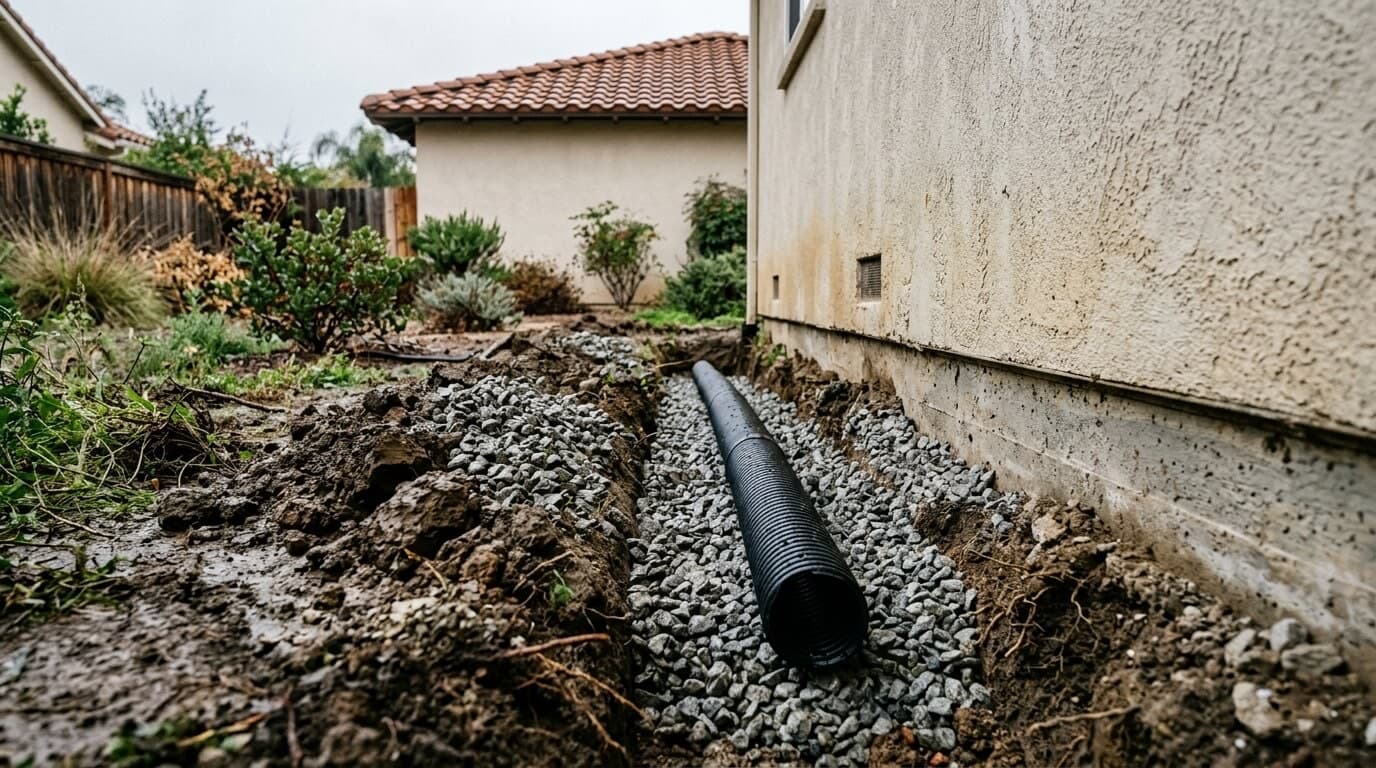
Two French drains of the same length can differ in price by a factor of five, and none of that spread is mystery. It comes from a short list of mechanical variables: how long the run is, how deep and wide the trench has to be, what pipe goes in it, what stone surrounds it, whether a machine can reach it, where the water exits, and what has to be rebuilt afterward. This article covers those variables and nothing else. Each one is a quantity a contractor measures and multiplies.
Planning a French drain? Describe your lot and where the water collects.
What a French drain estimate is actually pricing
An estimate prices four things: the hole, what goes into the hole, what comes out of the hole, and what has to be put back.
The assembly itself is simple and standardized. The International Residential Code describes a foundation drain as perforated pipe or drain tile resting on not less than 2 inches of washed gravel or crushed rock, covered by not less than 6 inches of the same material, with an approved filter membrane over the aggregate or around the pipe. A yard drain uses the same components in the same order.
Because the assembly is standard, the estimate is mostly arithmetic on quantities: linear feet of trench, cubic yards of excavation, cubic yards of stone, square feet of fabric, count of fittings, cubic yards of spoil removed, square feet of surface restored. On top of that sits a set of costs that do not scale with the drain at all — getting equipment to the property, the utility locate, and the outlet. Those fixed costs are why a 20-foot drain rarely costs a fifth of a 100-foot drain.
Run length: how linear footage scales excavation, pipe and stone together
Angi's French drain cost data, updated May 30, 2026, puts exterior French drain work at $10 to $50 per linear foot, which places a 100-foot exterior run between $1,000 and $5,000. The same publisher puts interior perimeter drains at $40 to $100 per linear foot and reports a national average of $9,250 across all French drain projects, within a full range of $500 to $18,000.
The reason the per-foot band is that wide is that a linear foot is not one cost. It is four costs stacked: excavation volume, pipe, stone and fabric, all of which increase together with every foot added.
Run the arithmetic on a 100-foot trench 12 inches wide and 24 inches deep. That is 200 cubic feet, or about 7.4 cubic yards of excavation. Subtracting the volume displaced by a 4-inch pipe leaves roughly 7 cubic yards of aggregate to buy, deliver and place. Fabric is priced by area, so a wider trench costs more fabric per foot, not just more stone.
What does not scale is equipment mobilization, the utility locate, the outlet, and the setup and cleanup around any restoration work. Fittings scale by count, not by length: NDS guidance in its exterior drainage course states that many systems require a grate or cleanout fitting every 50 to 100 feet, or at alignment changes of 45 degrees or greater. That means a straight 100-foot run and a 100-foot run with three corners are not the same job.
The practical effect is that per-foot cost drops as runs get longer. Short runs carry the fixed costs on very few feet.
Trench depth and width, and the spoil volume they create
Depth and width multiply, so they move cost faster than length does. Doubling trench depth doubles the excavation and doubles the stone for every foot of run.
Depth also changes what the excavation legally is. OSHA requires a stairway, ladder, ramp or other safe means of egress in trenches 4 feet or more deep (29 CFR 1926.651(c)(2)), and requires employees in an excavation to be protected from cave-ins by a protective system unless the excavation is entirely in stable rock or is less than 5 feet deep with no competent-person indication of cave-in potential (29 CFR 1926.652(a)(1)). Shoring, shielding or benching is equipment, and benching widens the hole.
Depth generates spoil, and spoil does not go back the way it came out. Excavated material bulks: Engineering ToolBox lists volume increases of roughly 20 to 40 percent for clay, 20 to 30 percent for sand and gravel, and 15 to 25 percent for loam. The 200 cubic feet from the example trench becomes roughly 240 to 280 cubic feet loose — 9 to 10 cubic yards to stage, spread or haul. Almost all of it is displaced by the stone, so most French drain spoil leaves the site. OSHA also requires excavated material to be kept at least 2 feet from the edge of the excavation (29 CFR 1926.651(j)(2)), so spoil needs staging room, and a site without staging room needs bins or immediate haul-off.
Depth has an upper mechanical bound as well. The USDA NRCS subsurface drain standard sets a minimum 2 feet of cover over drains in mineral soils, requires a safety factor of not less than 1.5 in computing maximum allowable cover, and caps standard corrugated plastic tubing at 10 feet of cover in narrow trenches, with heavy-duty tubing required beyond that.
Pipe specification: corrugated, rigid, sock, cleanouts
Pipe is a minor share of material cost and a major share of labor cost, because the specification decides how many joints get made and how they get made.
Single-wall corrugated polyethylene is covered by ASTM F405, which applies to 3- through 6-inch pipe and sets requirements for pipe stiffness, elongation, brittleness and perforations for underground soil drainage. It ships in coils, bends around obstacles, and produces very few joints across a long run. That is the fast option to install.
Rigid PVC is a different labor profile. ASTM D2729 covers thin-wall drain and sewer pipe; SDR 35 sewer pipe has a thicker wall and greater crush strength than D2729, according to U.S. Plastic Corp. Rigid pipe is assembled from lengths and fittings, and every direction change is a solvent-welded fitting that is priced and installed individually. It is also the specification used where crush loading matters, and where a cleanout will later be pushed with a drain cable.
Cover depth interacts with pipe class. ADS specifies a minimum of 1 foot of cover in trafficked areas for its 3- through 24-inch single-wall pipe. Under a driveway, that constraint alone can push a run deeper, which returns the job to the depth arithmetic above.
The sock is a purchasing decision with two forms. ADS offers single-wall pipe with a factory fabric sock to prevent infiltration of surrounding soils, which is a different SKU priced per foot. The alternative is lining the trench with geotextile, which is priced per square foot of fabric and adds a placement step. Both are filtration; they land on different lines of the estimate.
Cleanout count is its own multiplier. Each one is a fitting, a riser, a box, a lid, and — if it lands in paving — a surface penetration that has to be cut and finished.
Aggregate and filter fabric: stone size, washed vs unwashed, fabric grade
Stone is normally the largest material volume in the job, and "washed" is a processing specification with a price attached, not a preference.
The common drainage aggregate is No. 57 stone, graded under ASTM D448. The City of Boston's washed No. 57 specification lists the gradation as 100 percent passing 1-1/2 inch, 95 to 100 percent passing 1 inch, 25 to 60 percent passing 1/2 inch, 0 to 10 percent passing the No. 4 sieve and 0 to 5 percent passing the No. 8 sieve, and requires aggregate to be clean and thoroughly washed with a maximum wash loss of 0.5 percent under ASTM C117. Washing is a step the quarry performs and bills for; unwashed material of the same nominal size is a cheaper product.
Fabric is also graded rather than generic. AASHTO M288 specifies a Class 2 geotextile as the default for subsurface drainage applications, with permittivity and apparent opening size requirements attached. Higher survivability classes cost more per square yard.
Quantity follows the trench section directly. The 12-by-24-inch, 100-foot example needs roughly 7 cubic yards of stone and enough fabric to line the trench and lap it over the top. Placement matters too: stone that can be dumped from a machine bucket is cheaper to place than stone that has to be wheelbarrowed one load at a time.
Site access and equipment reach: machine trenching vs hand excavation
Access is the single variable most likely to double a labor line, because it decides whether the trench is cut by a machine or by people with shovels.
Compact equipment exists specifically for tight sites. A Ditch Witch C16X walk-behind trencher digs to 36 inches, and the larger C30X reaches up to 48 inches. Where a machine of that class can reach the work, a long trench is cut in a fraction of the time hand work takes.
Where it cannot — narrow gates, stairs, enclosed courtyards, structures or mature plantings in the path, no route for a machine to the back of a property — the same trench is dug by hand. Hand excavation is slower per foot and it also tends to be wider per foot, because a person needs working room in the trench. Extra width is extra spoil and extra stone, so access quietly raises material quantities as well as labor hours.
Access also governs spoil movement and stone delivery. A machine loads spoil into a truck or bin directly. A hand crew moves the same 9 or 10 cubic yards by wheelbarrow, twice — once out, once in with the stone.
Outlet type and distance: daylight, dry well, pop-up emitter, pumped discharge
The outlet is a small separate project with its own price, and the four common types are not close in cost.
Every option depends on fall. NDS gives a general guideline of 1/8 inch per foot, or 1 percent minimum slope, for smooth-interior pipe conveying runoff to a discharge point. Slope requirements mean that distance to the outlet is not just more trench — it is trench that gets deeper the farther it runs.
Daylight is the least expensive when grade permits it. NDS defines daylighting as discharging water from drain pipe onto the surface or into ditches. The NRCS standard requires a continuous section of rigid pipe without open joints or perforations at the outlet end, so the last stretch is a different material than the run.
Pop-up emitter adds a fitting and a specified approach. NDS describes the emitter as opening under the hydrostatic pressure of water in the pipe and closing again as flow diminishes, keeping debris and rodents out, and calls for 10 feet of perforated pipe ahead of the emitter.
Dry well is a second excavation. It is priced as its own hole, its own chamber or chambers, its own stone backfill, and its own spoil — on top of the drain run that feeds it.
Pumped discharge is the most expensive class because it adds a trade. The IRC allows drainage to discharge by gravity or mechanical means into an approved drainage system. Mechanical means a basin, a pump, a check valve, a sealed non-perforated discharge line, and a dedicated electrical circuit installed by an electrician.
Hardscape cut and restoration: concrete, pavers, decking, turf, irrigation
When a run crosses finished surface, restoration is frequently the largest single line on the estimate — larger than the drain.
Concrete has to be saw-cut, broken out, hauled away, then formed, poured and cured, and the cut is always wider than the trench so the patch has bearing.
Pavers are a defined procedure rather than a lift-and-replace. The ICPI Tech Spec on reinstatement of interlocking concrete pavements calls for removing pavers a few feet wider on each side of the trench opening, replacing and compacting aggregate base in 2 to 4 inch lifts, achieving a minimum 98 percent standard Proctor density on soil subgrade and 98 percent modified Proctor on base, crowning the reinstated area slightly to allow for settlement, and scattering replacement units through the existing field so weathering differences are less visible. That is a compaction specification with test methods attached, and it prices accordingly.
Decking is sometimes both an obstacle and the access route: boards and occasionally joists come out and go back, and fasteners and any damaged boards are replaced.
Turf restoration is priced by area and by method — sod is immediate and costs more per square foot than seed.
Irrigation is the line item most often discovered rather than planned. The national 811 service marks utility-owned lines only. Georgia 811 states that participating utilities will mark public utilities and that property owners must hire a private utility locator for private lines, listing irrigation systems, power to detached structures, propane lines and the water line between the meter and the home as owner-responsible. Sprinkler laterals crossing a drain run are typically found during excavation, and repair is added after the fact.
Permits, inspections and utility locates as a variable class
This is the one cost class driven by jurisdiction rather than by the drain, so it is best treated as a variable, not a number.
The model code frames the question. IRC Section R105.1 requires any owner or owner's authorized agent intending to construct, enlarge, alter, repair, move, demolish or change occupancy of a building or structure to apply to the building official and obtain a permit, and R105.2 lists exemptions, including sidewalks and driveways and retaining walls not over 4 feet in height measured from the bottom of the footing that do not support a surcharge. Whether a given subsurface drain, dry well or pumped discharge falls inside or outside that framework is determined locally, and the answer changes the fee, the drawing requirement and the inspection schedule.
Utility locates are separate from permits and are not optional. OSHA requires the estimated location of utility installations to be determined before opening an excavation and requires the utility owners to be contacted within established response times (29 CFR 1926.651(b)(1) and (b)(2)). 811 is described by the national service as the free national before-you-dig service, contacted a few business days ahead of digging, followed by a waiting period for utilities to respond. The direct fee is zero; the cost is calendar time, which shows up as schedule, not as a line item. Private locates, where private lines are in the work area, are a paid service.
Weighing contracted work? Describe the run and where the water has to go.
DIY versus contracted work
Doing the work yourself removes the labor line, which Angi's 2026 cost data puts at 60 to 70 percent of the total project budget for professional installation. Every other line survives: equipment rental or purchase, stone delivered by the cubic yard, pipe and fabric and fittings, disposal of bulked spoil, the locate wait, and all restoration.
The trade-offs are physical rather than administrative. OSHA's protective-system requirement at 5 feet applies to employees in an excavation (29 CFR 1926.652(a)(1)); the cave-in mechanics that rule addresses do not change based on who is holding the shovel. Slope error is the other common cost: a run that fails the 1 percent minimum has to be re-dug, and the stone is not recoverable once it is mixed with spoil.
Putting the variables together
Every item above is a quantity multiplied by a unit. Length sets four quantities at once. Depth and width multiply them. Pipe class sets the joint count. Aggregate specification sets material price per yard. Access sets the labor rate per foot. The outlet is a separate small project. Restoration is priced by surface, not by drain. Permitting is a jurisdictional variable.
What that list deliberately leaves out is the site itself. Soil behaviour, lot grading and available discharge points differ enough between markets that an identical specification prices differently from one to the next — for how those conditions apply in Temecula, see what changes an estimate locally.
Yard drainage help by city
What a French drain costs depends on the lot, and the lots differ across the valley. Yard drainage pages by city: Temecula, Murrieta, Menifee, Wildomar, Lake Elsinore, French Valley, Winchester, Homeland, Lakeland Village, Fallbrook and De Luz. For the services themselves, see yard and landscape drainage, French drain installation, grading and drainage correction and downspout and gutter drainage.