
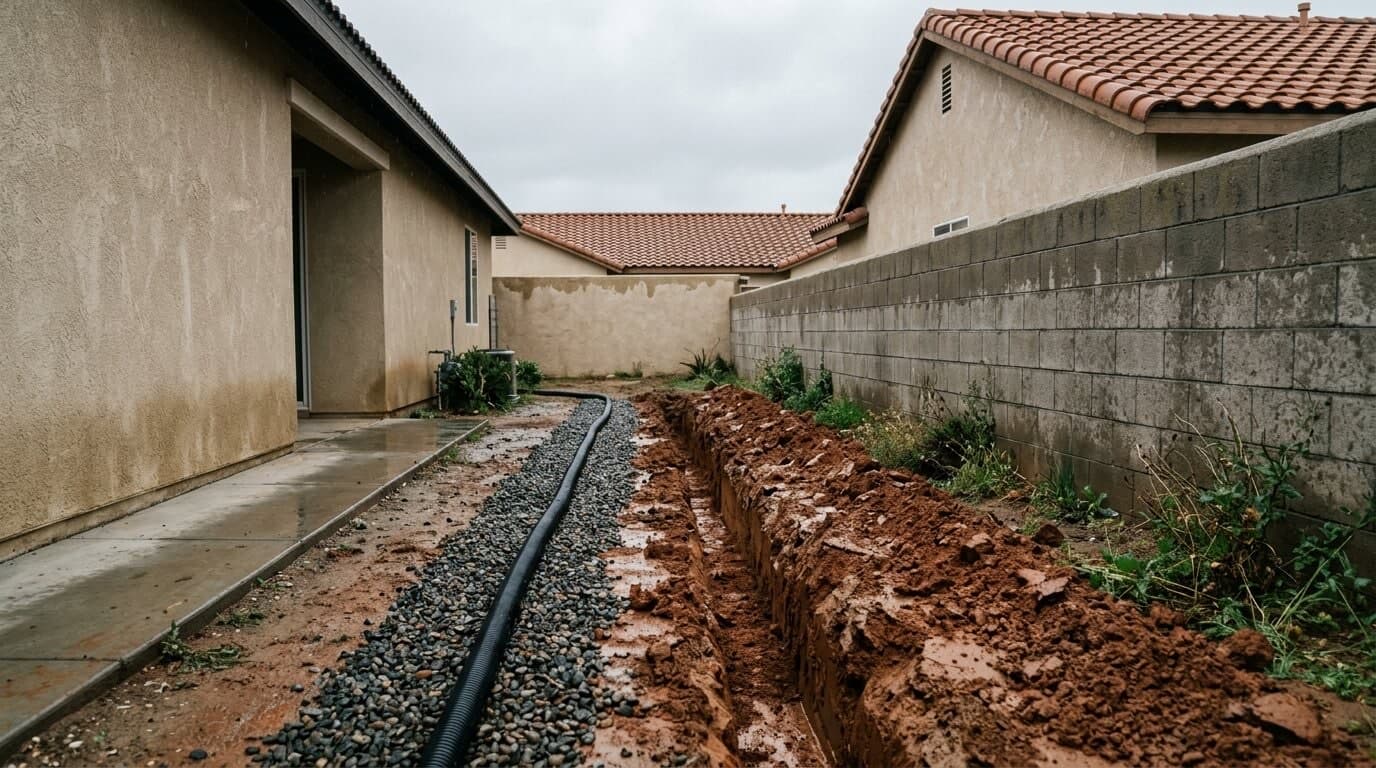
Two questions get typed more than any others around this work: how much does it cost to fix backyard drainage, and how much is a drainage contractor. Neither has a portable answer, and the reason is not the local market rate. An identical drain, built to an identical specification, is a different job in Temecula than it is thirty miles west, because the ground under the lot and the discharge point available to it are different. Soil that will not accept water rules out entire designs. Rock at knee depth sets a floor the trench cannot pass. A graded pad decides where water collects before anyone picks a wet spot. What follows is the local site conditions that decide which drain is even buildable on a given Temecula parcel — the input that moves the number before any mechanical variable does.
With a strong El Niño forecast for this winter, the El Niño winter guide covers what to check on a yard before the rain starts.
Planning a French drain in Temecula? Describe your lot and where the water collects.
Auld and Murrieta clay soils remove infiltration from the design menu
Water does not soak away on Temecula's upland soils, so a drain here has to carry water somewhere rather than store it. The USDA-NRCS Official Series Description for the Murrieta series — whose type location sits about seven miles west of Temecula — describes a B horizon of 35 to 50 percent clay with slow permeability. The Auld series, mapped across the same foothills and uplands, is a fine, smectitic soil, also rated slow permeability, with surface cracks half an inch to an inch and a half wide and prominent slickensides at depth: the signature of clay that swells when wet and shrinks when dry.
That combination takes a whole class of solution off the table. Any design that depends on water leaving through the sides and bottom of a buried void — a dry well, an infiltration pit, a soakaway — assumes the surrounding soil will accept it. On a 35-to-50-percent-clay profile rated slow permeability, the void fills during the storm and stays full afterward. The design that remains is one that intercepts water and conveys it to a discharge point off the lot. That is a site condition, not a preference, and it is the first thing that separates a Temecula estimate from one written on sandy ground.
Basalt at 12 to 20 inches is a depth ceiling, not a depth choice
A trench on Murrieta-series ground stops where the rock starts. The Murrieta OSD puts hard basalt at 12 to 20 inches below the surface. That is shallower than most people picture when they imagine a subsurface drain, and it is a hard physical limit rather than a matter of how far someone is willing to dig.
The practical consequence is that a design specified around reaching a particular depth may simply not exist on those map units. Whatever interception the drain performs has to happen in the material above the rock. It also explains a symptom people describe without knowing the cause: on shallow-rock ground, water moving down through the profile reaches the basalt, cannot continue, and travels laterally in the thin layer above it. That shallow perched flow is what keeps a lawn soggy for days after the surface has dried, and it is why re-grading alone does not always resolve it. Two parcels a few streets apart can sit on different map units, and that difference alone changes what can be built.
Pad-and-slope tract construction decides where the water collects
On a Temecula tract lot, water goes where the grading engineer sent it, not where the natural terrain would have. City of Temecula Public Works grading notes treat graded slopes and pads as regulated, engineered features — requiring berms at the top of graded slopes to direct runoff away, requiring existing drainage courses to keep functioning, and requiring adjoining properties to be protected. A lot built under that regime is a flat building pad with manufactured slopes around it and a designed path for surface water.
That produces a predictable geometry. Water sheets off the pad toward its low edge and concentrates at the toe of the manufactured slope, in the narrow side yard between two houses where two pads drain into one channel, and at whatever point the designed path was meant to carry it. These are not random wet spots — they are the places the original grading collected water on purpose. Diagnosing a Temecula lot means reading that intended path first and finding where it stopped working, because a drain placed at the visible puddle rather than the collection point treats a symptom.
The local housing stock: builder grading now 25-plus years old
Most Temecula houses are single-family homes whose original grading is around three decades old. Census ACS 2020–2024 five-year estimates put the median year structure built at 1998, with 22,878 of 37,813 housing units — 60.5 percent — built between 1990 and 2009, and 28,993 units, 76.7 percent, single-unit detached. As of 2026 that median house is 28 years past its grading inspection.
Grading does not hold that shape indefinitely. Engineered fill settles. Landscaping is added, raised, and replaced. Planters, raised beds and slope plantings alter the surface the original design relied on. The fall that carried water away from the foundation flattens, and in places reverses. So the common Temecula case is not a defective lot but a lot whose correct original grading has aged out — which changes the diagnosis, because the target is restoring a designed condition rather than inventing one.
Four City of Temecula grading requirements bound the design
Temecula's published grading notes name specific requirements that a drainage correction on a graded lot has to satisfy. Four of them shape the design directly.
A grading permit is required before grading work begins. The city treats grading as permitted work, so the sequence on a corrective job starts with that approval rather than with excavation.
Graded slopes must carry berms at the top that direct runoff away from the slope. A berm on a manufactured slope is a required feature, not an optional one — a design cannot resolve a wet spot by removing it or cutting through it to let water spill down the slope face.
Concrete surface drainage is held to a minimum grade of 0.5 percent. Any concrete drainage surface in the corrected design has to fall at least that much. Where a settled lot no longer offers 0.5 percent between the wet area and the discharge point, the design has to find that fall somewhere.
Cut and fill slopes are limited to 2:1 maximum. Where corrective work reshapes a slope, that is the steepest it may be rebuilt, which fixes how much horizontal room the reconstruction consumes.
These four are the local constraints on what the finished work has to look like. They apply to the design, and they are specific to this jurisdiction.
In a tract neighborhood, the curb and the city storm drain are the outlet
For most Temecula lots the available discharge point is the street. The City of Temecula Stormwater Management Plan describes a municipal system of 52 miles of city storm drains, seven miles of improved open channels and 22 miles of Riverside County Flood Control facilities, with runoff conveyed by streets, curb and gutter, catch basins and storm drains. Those facilities ultimately discharge to Murrieta Creek and Temecula Creek, which join to form the Santa Margarita River.
Two things follow. First, in a tract neighborhood a legal discharge point exists and is close, so the question of where the water finally goes has a straightforward answer. Second, the grading notes require existing drainage courses to keep functioning and adjoining properties to be protected, which forecloses the shortest path a wet lot often appears to offer — the neighbor's lower lot, or the slope that drains toward it. The design has to reach the street or an approved on-lot device. Which of those a particular parcel has is a property of the parcel, and it is settled before anything is specified.
Wine-country parcels east of the city have no street system in reach
East of Temecula, the outlet the tract lots rely on does not exist. Eastern Municipal Water District describes Temecula Valley Wine Country as an area that historically relied on individual septic systems with leach fields, now transitioning to sewer as it grows. Those parcels are large, rural, and not served by curb, gutter and catch basin.
That removes the street from the design and adds a constraint the tract lots do not have. Water has to be discharged on the property itself, and it has to be kept clear of the septic disposal field — a leach field depends on unsaturated soil beneath it, so routing collected water toward or across one works against the system the house depends on. Locating the discharge point on a wine-country parcel is therefore a siting problem constrained by the leach field and by the natural low ground, and it is resolved before the drain's route can be drawn. Two houses in the same ZIP code, one in a tract and one on acreage, are not comparable jobs. Establishing which of the two a given address falls under is therefore the first step in any French drain installation in Temecula, because the outlet decides the design before anything mechanical does.
Want a French drain for your Temecula lot? Describe where the water collects.
Why the same specification prices differently here
There is no single figure that answers "how much does it cost to fix backyard drainage," because the specification that fits a Temecula lot is decided by conditions the lot brings with it: whether the soil will accept water at all, how deep the trench can go before it meets basalt, where the original pad grading concentrated flow, how much that grading has moved in the 28 years since the median house was built, what the city's grading standards require of the finished work, and whether the parcel has a street outlet or has to resolve discharge on its own ground around a leach field. Two lots with the same square footage and the same visible puddle can require different work because those answers differ. That is why the honest response to "how much is a drainage contractor" is that the rate is not the variable doing the work — the site is.
The mechanical drivers behind any French drain estimate — run length, trench depth, pipe and aggregate specification, equipment access, outlet type and hardscape restoration — are covered separately in what moves the cost of a French drain.
Get yard drainage help in Temecula
If the water on your Temecula lot is already a problem, these pages cover the work: yard and landscape drainage in Temecula, French drain installation in Temecula, grading and drainage correction in Temecula and downspout and gutter drainage in Temecula.