
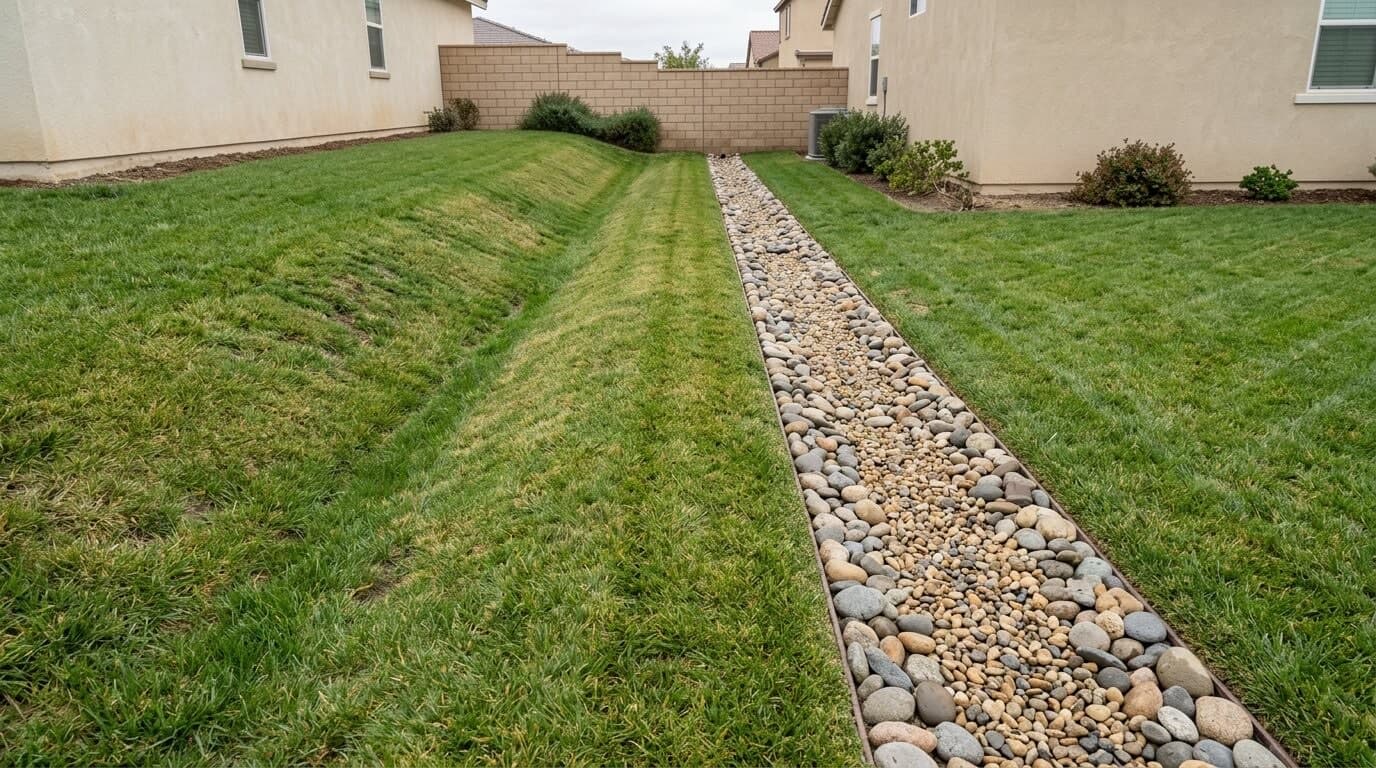
A French drain collects water below the surface. Regrading changes where water goes on top of it. Both are used on Murrieta yards, and they are not interchangeable. Which one fits depends less on how the yard looks than on three things about the lot: what kind of lot it is, where the water is, and what the ground does with it.
French drain or regrading for your Murrieta yard? Describe where the water collects.
Three kinds of Murrieta lot
One group is lots in the built-up neighborhoods, where the General Plan says storm drain systems are most common. A second group sits on hillsides, where the City's code treats slopes of 25 percent and steeper as a hillside condition and prohibits development on slopes of 50 percent and over. A third is rural acreage in the parts of the city where, according to the General Plan, developed land does not support or require storm drains.
Each group tilts the choice a different way, which is why the first question about a wet yard in Murrieta is where the lot sits.
On a tract lot, the usual problem is lost fall
A tract lot is normally graded so that water leaves toward the street. That fall can disappear without anyone noticing. Landscaping gets rebuilt, planters and slabs go in, and soil settles. The City's General Plan documents a severe case in the California Oaks area, where alluvium left in place during rough grading later collapsed when groundwater rose or irrigation reached it, damaging structures and cracking the ground.
That is one documented neighborhood and the plan does not describe individual lots, but it shows how a graded surface can change after the fact. If water stands on a flat spot, or the ground tips toward the house, the fix is on the surface: regrading to restore the fall. The model residential code asks for ground to fall at least 6 inches in the first 10 feet away from the foundation, as inspectors read it. A 4-foot level and a tape measure will show whether a lot still does.
Why the clay narrows the options
The same plan reports expansive clay layers in the Pauba formation and in the alluvial valley deposits, and describes clay that expands when wet and shrinks when dry. The practical point is that a fix which relies on the ground to take in water is a poor bet. Both remedies here are about where the water leaves. A drain needs an outlet, and regrading needs somewhere legal and lower to send the water.
When the water is not on the surface
A yard that is soft with nothing standing on it, or that gets wet again days after the rain, is a different case. Regrading will not help, because the water is not arriving across the surface.
The General Plan puts groundwater at 10 to 30 feet in some areas. That is too deep to explain a soft lawn on its own. A likelier source, as a matter of reasoning and not something the plan states, is seepage at the base of a slope. The plan describes the sediment that collects there as silty sand and sandy gravel with angular fragments of the bedrock above. Intercepting that water below the surface is what a French drain does.
On a steep lot, the City decides how much earth can move
At 25 percent and steeper, Murrieta's hillside standards apply, and as the code summarizes them they limit development on slopes of 25 to 50 percent to places where grading and its impacts can be kept small. Regrading a slope like that is likely to be a project the City reviews, not a weekend job. In general a subsurface drain moves less earth, which can matter on a slope, but whether a specific scope is allowed is the City's decision, and a surface fix that sends water across a steep slope can create the erosion it was meant to avoid.
When both are indicated
Some lots need both. A lot that has lost its fall and also has a seeping slope behind it is the usual example. The surface should come first, because a buried drain does not correct a surface that sends water at the wall. Once the water on top is going the right way, what remains is the water in the ground.
Not sure whether your Murrieta yard needs regrading or a drain? Describe what you see.
A quick way to read a lot
| What the lot shows | Likely remedy | What would change the answer |
|---|---|---|
| Water stands on flat spots, or the ground tips toward the house, after rain | Regrade to restore the fall | No fall is available to a legal outlet; then collection and a piped run |
| Soft ground with nothing standing, wetness that returns without rain, or seepage at the base of a slope | Subsurface drain | A surface route that was never checked; check it first |
| A slope behind the house of 25 percent or more | Confirm with the City what work is allowed; a subsurface drain usually moves less earth | The City's review of the specific scope |
| Rural parcel with no storm drain | Either one, depending on where the outlet can go | No workable outlet on the parcel |
| Fall lost and a seeping slope behind it | Surface first, then the drain | The drain alone clearing the problem |
The table keys on what the lot shows, not on how the puddle looks. Two yards with the same standing water can sit in different rows.
If the water is sitting on a patio, pool deck or driveway and not in the soil, the problem is the hard surface itself, covered in the Murrieta hardscape drainage guide.
Get yard drainage help in Murrieta
If the water on your Murrieta lot is already a problem, these pages cover the work: yard and landscape drainage in Murrieta, French drain installation in Murrieta, grading and drainage correction in Murrieta and downspout and gutter drainage in Murrieta.