
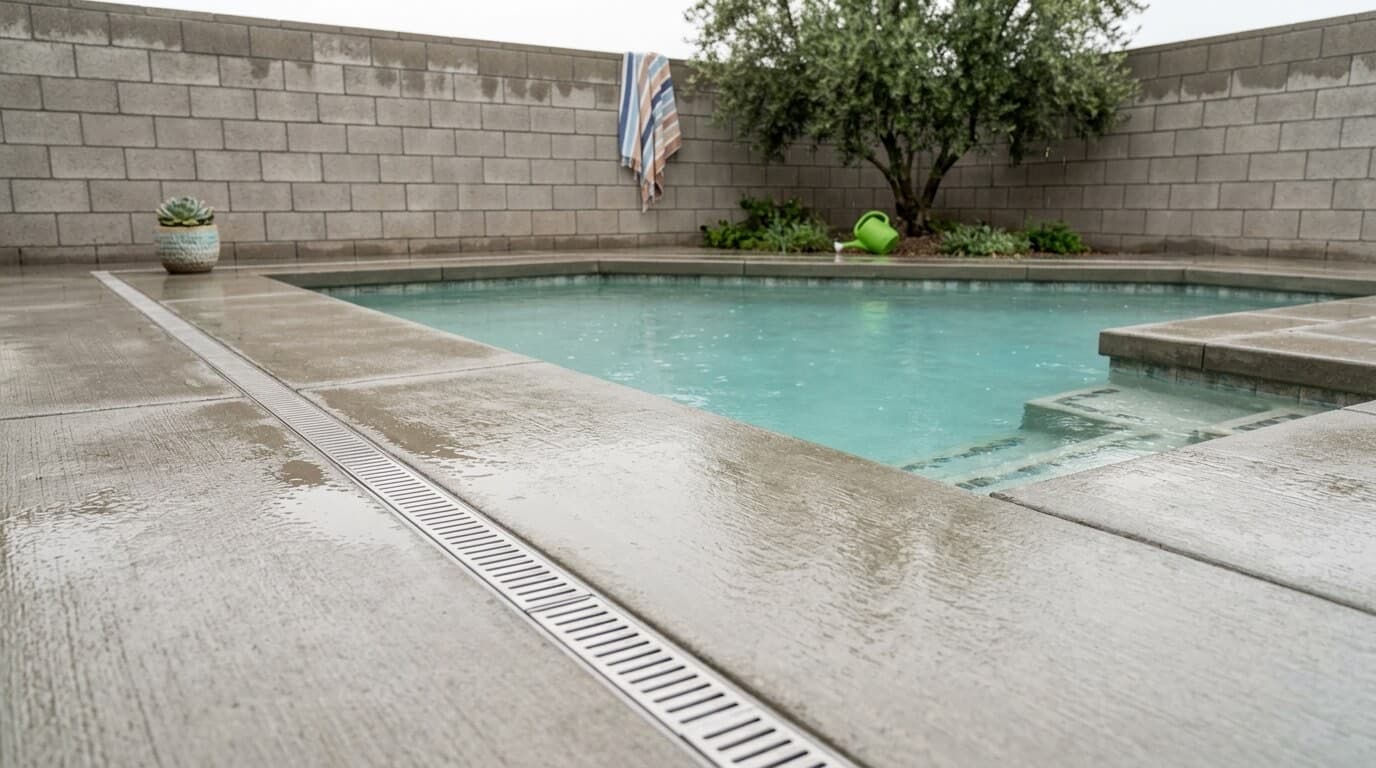
A patio, a pool deck or a stretch of backyard concrete absorbs none of the rain that lands on it. All of it runs off, and where it runs is set by two things: the pitch of the surface and whatever sits at its edge. Murrieta's General Plan makes the general point: paved surfaces reduce the water that soaks into the ground, and rain, irrigation runoff and nuisance flows collect on them and move downstream. In a backyard, "downstream" is a few feet of soil, a fence line or a gate.
Water standing on a Murrieta patio or pool deck? Describe where it goes.
Where the water on a slab is supposed to go
Any surface that touches the house has a standard to meet. The model residential code (section R401.3) says concrete and other impervious surfaces within 10 feet of the foundation should slope at least 2 percent away from the building, as the InterNACHI inspector guide explains. Two percent is about a quarter inch of drop per foot. A 4-foot level and a tape measure will tell you: set the level on the slab, pointing away from the wall, and the far end should sit roughly an inch below the near end.
Pool decks have their own rule of thumb. California's building code section on pool decks, 3114B.3, calls for a slope of 1 to 2 percent, or an eighth to a quarter inch per foot, away from the pool to a drainage system, with the surface finished to prevent standing water. That section sits in the code's chapter for public pools, so it is a reference point for a backyard deck and not the rule for one. The industry's residential standard, PHTA-5, says the same thing in general terms: a deck should slope to drain away from the pool or toward deck drains.
The edge matters as much as the pitch. A slab can be pitched correctly and still hold water if the edge hands it to a flowerbed that sits higher, a raised border, or soil that has settled into a lip.
What the symptoms usually mean
Water still standing hours after the rain has stopped means a low spot or a dam. The low spot may be in the slab. The dam is often at its edge, where soil, mulch or a border has built up against the concrete.
Water running toward the house wall means the surface is pitched the wrong way, which fails the 2 percent test above. It is common where a patio was added or raised after the house was built.
White powdery deposits on the face or edge of a slab are efflorescence. The trade publication Concrete Network says it needs moving moisture to form, and that rain, standing water and sprinklers all make it worse. In practice it is a sign that water is working through or under the concrete, which points back to where the water is going.
A side yard beside the patio that never dries is usually the place the patio's runoff lands. If the soil there stays soft, the route out of the yard is slower than the water arriving at it.
Why the edge of a slab is where trouble shows
The City's General Plan notes that clay-rich soils in Murrieta expand when wet and shrink when dry, with reported cases of expansive clay layers in the Pauba formation and in alluvial valley deposits, and that the change in volume can stress buildings and other structures. The plan does not mention patios. The reasoning that follows from it is that soil at a slab edge, where runoff lands, goes through more wet and dry cycles than the soil under the middle of the slab. That is where gaps and cracks tend to open. It is an inference, not a finding about any particular patio.
What a built-out lot leaves to work with
A finished backyard has fixed points: the elevation of the slab compared with the ground around it, the width of the side yard, the pool shell and its footings. The fix has to fit around those.
For placement, a channel drain suits a long edge where water arrives along its whole length, such as the low side of a patio. A catch basin suits a single low spot. Which device is better for a given lot is a separate question. What matters here is that both only collect water, and what they connect to decides whether they work.
The Murrieta plan says storm drain systems are most common in the more urbanized parts of the city, while developed land in the more rural parts does not support or require them. Which one a parcel has changes what a drain can connect to.
Where a hardscape drain is allowed to discharge
Most backyard fixes end at one of three places: a lower part of the yard, a swale, or the street. The street needs care. Murrieta's stormwater page says that under the City's stormwater permit, any discharge to the storm drain beyond stormwater itself, over-irrigation included, counts as an illegal discharge unless a separate permit covers it or it is regulated, and that the City enforces this under Chapter 8.36 of its code. The General Plan adds that storm drains are not connected to the sanitary sewer, so what enters them reaches surface waters without treatment.
The page does not name pool water or deck wash. Rain runoff off a clean slab is one thing. Water that has been through a pool, or wash water from the deck, is another. Before pointing a deck drain at the curb, confirm with the City what is allowed. Whether and how a pipe may reach the curb at all is also the City's decision.
Before the next storm
Watching the slab once in real rain tells more than any measurement. Look for these:
- Where the first puddle forms, and how long it is still there after the rain stops.
- Which way water moves across the surface. A few leaves or bits of mulch show the direction.
- What the water meets at the edge of the slab, and where it goes after that.
- Whether the side yard is wet or draining, and how far along it the wet part runs.
A few phone photos taken during the storm are worth more than a description given afterward.
Water pooling on a patio or deck, or heading for the house? Describe where it goes.
When the problem is more than the surface
If the slab is pitched correctly and water still collects beyond its edge, the problem is the yard, which is the territory of yard drainage work in Murrieta. Where the whole lot has lost its fall, the fix is regrading. Whether the real problem is water on the surface or a lot that lost its fall is its own decision, set out in French drain vs. yard grading in Murrieta. With a strong El Niño forecast for this winter, the El Niño winter guide lists checks for the whole yard.
Get yard drainage help in Murrieta
If the water on your Murrieta lot is already a problem, these pages cover the work: yard and landscape drainage in Murrieta, French drain installation in Murrieta, grading and drainage correction in Murrieta and downspout and gutter drainage in Murrieta.