
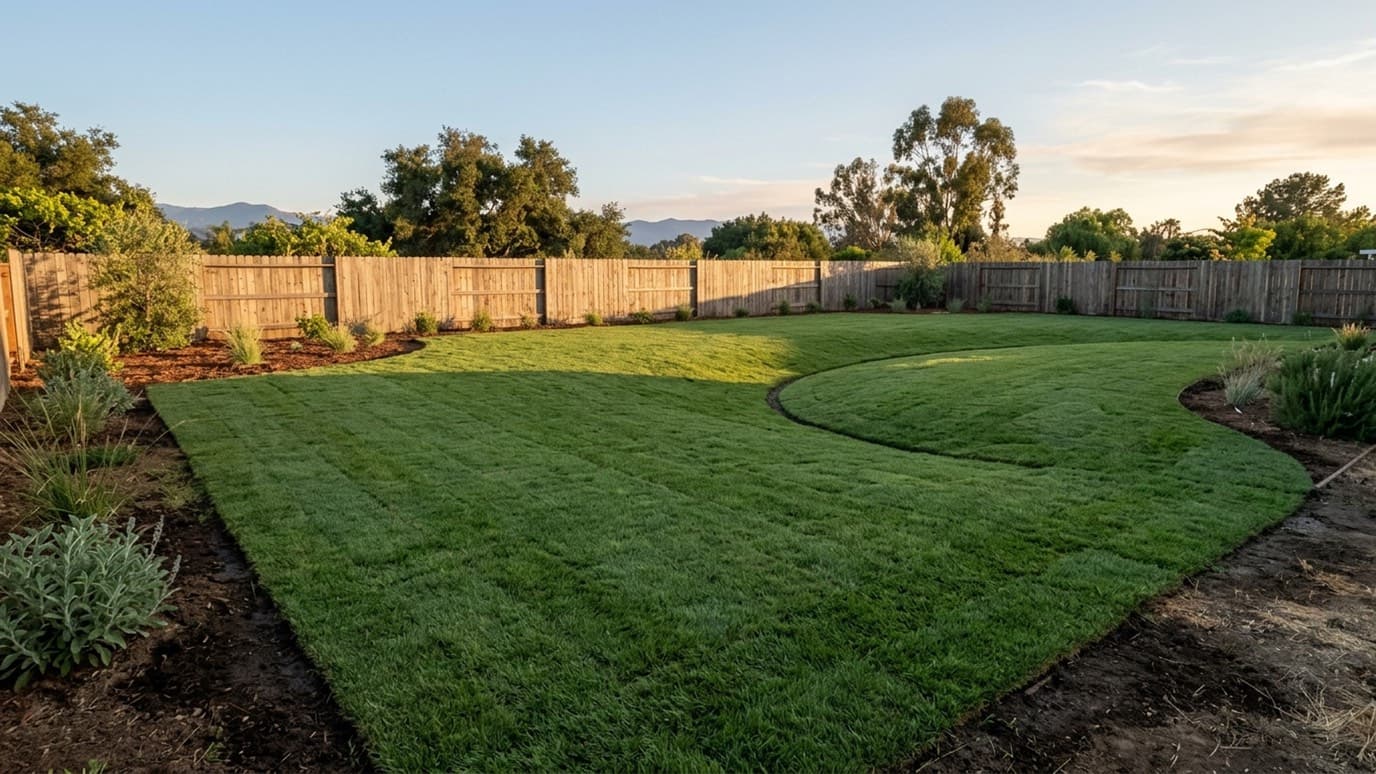
A yard drainage fix in Wildomar starts with three questions: which way the lot drains, whether the street in front of it has a curb to drain to, and what the City allows once the water leaves your property. The answers differ across the city, and they decide whether the right landscape drainage repair is regrading, a drain, or a way to carry the water to an outlet. This guide works through each.
Standing water in your Wildomar yard? Describe where it collects and what the street looks like.
Which way your Wildomar yard drains
Wildomar does not drain in one direction. The City's 2019 Master Drainage Plan puts the northwestern part of the city, which it calls Region S, in the Santa Ana River watershed, with storm runoff flowing west toward Lake Elsinore. It puts the central, eastern and southern parts, Regions W and M, in the Santa Margarita watershed, with runoff flowing southwest. The same plan sets its street criteria: contain 10-year runoff within the street curbs and 100-year runoff within the street right of way. A yard that floods in a modest storm is therefore more likely a local outlet problem than a street that cannot carry the water, which is reasoning from those criteria.
Many streets have no curb
The City's own Local Hazard Mitigation Plan states that the city has over 53 miles of dirt roads, and that rain and erosion leave many of them impassable each winter. On a dirt frontage there is no gutter to drain into and no inlet to reach, so the outlet has to be found on the lot or in a graded roadside path. That is reasoning from the plan's statement.
Where a street does have a curb or a right of way, the City's code governs what you can do to it. According to the Municipal Code, no one may make an excavation, backfill or improvement in a City street or its right of way without a permit from the Transportation Director (section 12.08.020), and it is a violation to establish or continue an illicit connection to the storm drain system (section 13.12.070). Those code sections come from earlier research and were not re-opened for this page, so confirm them with the City. For the roads themselves, the County's road standards list a private drain through curb (Standard 310), and Wildomar's improvement standards follow County specifications.
Slow soil and shallow bedrock
A geotechnical report for a Wildomar site at Baxter Road and Central Avenue found the Pauba Formation at the surface down to about 51½ feet, clayey sand soils, and tested infiltration rates of 0.12 and 0.46 inch per hour. It did not encounter groundwater, and cited nearby wells indicating depth to groundwater of 50 to 100 feet. That is one site, and it says nothing about the next lot, but it shows how little water some Wildomar ground takes in. The County's infiltration testing guidance applies a factor of safety of 3 to percolation results, which cuts those rates further. A dry well or other infiltration is a weak default on soil like that, and a site test settles it.
Older parcels and newer tracts
The Census Bureau's 2020 to 2024 estimates count 11,251 housing units in Wildomar. Of those, 4,548 were built between 1970 and 1989 and 4,516 in 2000 or later. A repair on an older parcel may have to create a route for the water, since the lot may predate any drainage system. On a newer tract pad, the usual job is finding where the original grading plan was defeated. Both are reasoning from the housing mix and not findings about any street.
Regrading and the fence line
Landscape drainage repair often means moving dirt, and in Wildomar there is a code trap in it. The development code measures fence height from the finished grade at the base of the fence, and says grade cannot be modified to increase fence height. Piling dirt along a fence to push water away can therefore create a code problem, which is worth checking before a swale turns into a berm. That section was also read in earlier research and not re-opened for this page.
Which fix fits which lot
| What the lot looks like | The usual fit | What rules it out |
|---|---|---|
| Water stands on a flat or dished yard, and a lower point exists | Regrading to restore fall | No lower point, or a fence line that limits how much grade can move |
| Soft ground that stays wet after the surface has drained | A drain, see French drain installation, after the surface is corrected | An outlet that cannot be reached or permitted |
| Roof water landing at the wall | Downspout drainage carried to an outlet | Counting on slow soil to take it in |
| A dirt street with no curb | An outlet found on the lot or in a graded roadside path | Any work in the right of way without a permit |
| A street with a curb | A permitted private drain through the curb | A connection no one has approved |
Not sure which fix your Wildomar yard needs? Describe the lot and where the water goes.
Get yard drainage help in Wildomar
These pages cover the work: yard and landscape drainage in Wildomar, French drain installation in Wildomar, grading and drainage correction in Wildomar and downspout and gutter drainage in Wildomar. For a wider look at the causes of standing water, see the yard flooding guide.
FAQ
Where does the water from my Wildomar yard end up?
It depends on which side of the city you are on. The City's Master Drainage Plan puts the northwestern part in the Santa Ana River watershed, draining west toward Lake Elsinore, and the central, eastern and southern parts in the Santa Margarita watershed.
Do I need a permit to run a drain out to the street?
Probably. The City's code says no one may excavate or build an improvement in a City street or its right of way without a permit from the Transportation Director, and an unapproved connection to the storm drain system is a violation. Ask the City before digging.
Can I raise the dirt along my fence to push water away?
Be careful. The development code says fence height is measured from the finished grade at the base of the fence and that grade cannot be modified to increase fence height. Check the rule before the dirt goes in.