
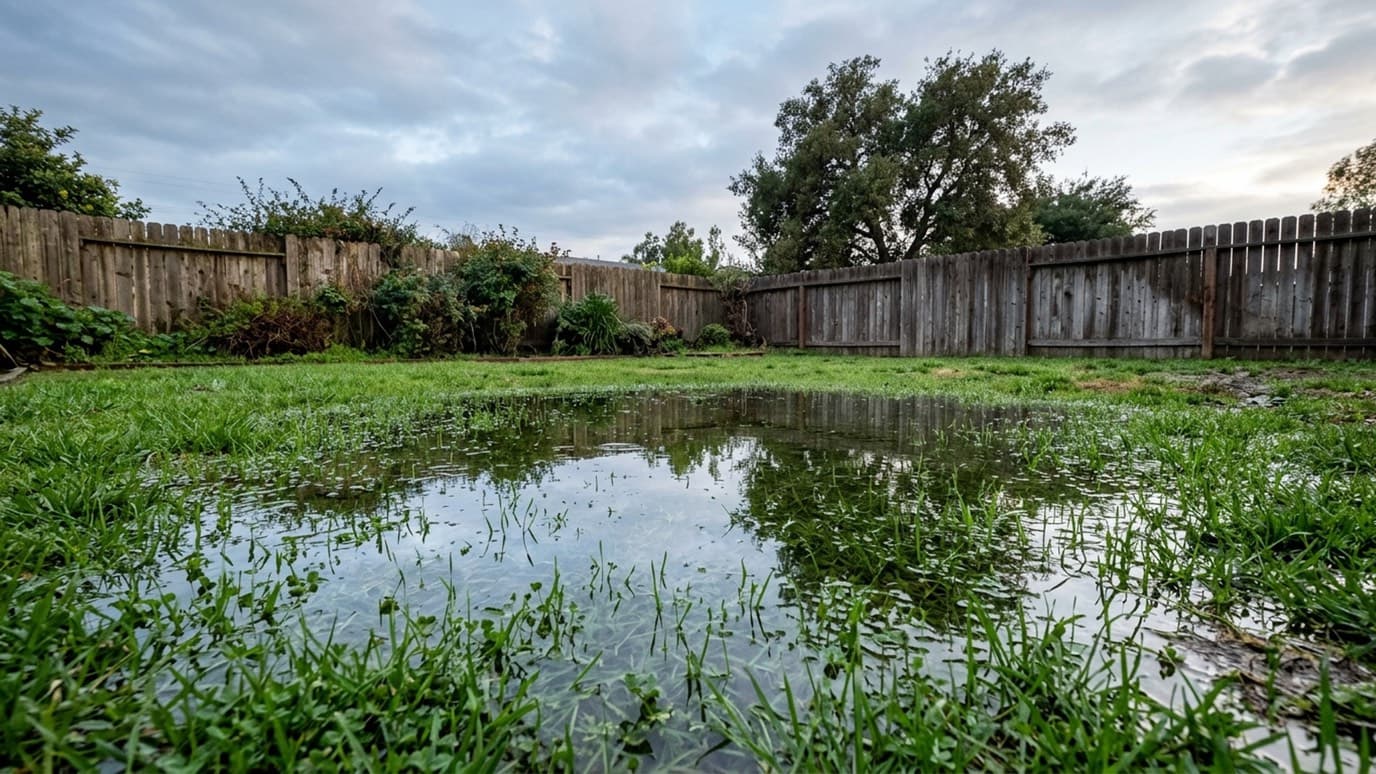
A yard floods because more water arrives than leaves. Standing water in your yard comes from a few usual causes, and each has its own fix: a downspout that empties in the wrong place, ground that has lost its fall, a patio that sheds onto the lawn, soil that will not drain, or a drain that has stopped working. Find the cause and the right yard drainage solution follows from it.
Backyard flooding or standing water in your yard? Describe where it collects and where the downspouts end.
Standing water in your yard: what you see and the fix
| What you see | The usual cause | The fix |
|---|---|---|
| Wet ground when it has not rained | Irrigation or a leak | Repair or reschedule the system; see the sprinkler check below |
| Water pooling at the wall, near a downspout | Roof runoff | Downspout and gutter drainage; options in the downspout drainage guide |
| Water standing against the foundation after the rain stops | Roof water, a flat grade or a low spot | Grading and drainage correction; see water pooling against a foundation |
| Water running down the driveway toward the garage | The driveway's slope | A channel drain or regrading; see driveway and garage flooding |
| A patio, pool deck or walkway shedding onto the lawn | Hardscape | Yard and landscape drainage; see patio and pool deck drainage |
| Water running in from a slope above the yard | Hillside runoff | Retaining wall and slope drainage |
| A puddle on bare, hard ground that soaks in slowly | Compacted soil | Loosen the ground, or give the water a path with yard drainage |
| A drain or emitter that used to work and now overflows | A clogged or failed drain | Clear, repair or replace it |
| Soft ground that stays wet after the surface has drained | Water moving through the ground | French drain installation after the surface is corrected; see French drain or regrading |
Two rows can be true at once. A yard with a flat spot and a downspout that empties into it has two causes and needs both fixed. The surface comes first, because a buried drain does not correct a surface that sends water at the wall.
What is different in the Temecula Valley
Much of the advice on yard drainage is written for other climates. Four local facts change how it applies here.
- The clay drains slowly. The USDA's description of the Auld series, found in the foothills and interior valleys of southern California, gives slow permeability and surface cracks a half inch to an inch and a half wide in dry periods. The Murrieta series, which occurs a few miles west of Temecula, is also slow-permeability clay. Water that cannot soak in has to leave across the surface or through a drain.
- The rain comes in a short season. The Auld description puts average annual precipitation where it occurs at 10 to 16 inches, with long dry summers and short mild winters. A season like that tends to leave the ground dry and hard when the first storm arrives, which is reasoning, not a measurement of any yard.
- Many lots are decades old. About 60 percent of Temecula's housing units, 22,878 of 37,813, were built between 1990 and 2009, according to the Census Bureau's American Community Survey (2020 to 2024 estimates, with a margin of error). That grading is between 17 and 36 years old. Fill settles and yards get rebuilt, so the original fall can be gone.
- The city has its own rules. The City of Temecula's grading notes say existing drainage courses must continue to function at all times and ask that adjoining properties be protected during grading. Water cannot simply be aimed at a neighbor.
Rule out the sprinklers first
The cheapest cause to check is the one you control. If the yard is wet when it has not rained, the water is coming from the irrigation system or a leak. Rancho California Water District, based in Temecula, lists soft spots on the lawn and around a sprinkler as a sign of a leak being absorbed into the ground, and lists puddles and runoff in the yard among its warning signs. Its leak-locating page also describes a meter check: shut off the main valve to the house, and if the meter still moves, the leak is outside the house. The district offers no-cost irrigation system evaluations to residential customers. If another district supplies your water, its website will have the equivalent.
The EPA's WaterSense checklist adds a walk-through while the system runs, looking for pooling or spraying where it should not, and lists valves, connection points, joints and sprinkler heads as the usual leak points.
Roof runoff, grading and hardscape
Roof runoff. A roof turns every inch of rain into hundreds of gallons, which is arithmetic: an inch over 1,000 square feet is about 620 gallons, and Pender County, North Carolina gives 625. All of it leaves through a few downspouts, and a downspout that empties at the wall delivers that water to one spot.
Grading. Ground that falls toward the house, or has a flat spot or a dip, holds water that ground sloping away would shed. The 2025 California Residential Code, in section R401.3, asks for the grade to fall at least 6 inches within the first 10 feet from a foundation wall, and where lot lines, walls or slopes prevent that, for drains or swales to be built to carry the water away. It is the standard new lots are graded to, not a rule on an existing yard, but it is a useful yardstick.
Hardscape. Concrete, pavers and decking take in none of the rain that lands on them, so whatever falls on a patio or pool deck leaves along its edge. The same code asks that paved surfaces within 10 feet of the foundation slope at least 2 percent away from it.
Compacted soil and drains that stop working
Compacted soil. Ground that has been packed down takes in water slowly. Nebraska Extension reports that compaction reduces the rate of water infiltration and drainage, and lists water ponding and excessive runoff during rain among the signs. Colorado State University lists the causes: repeated foot traffic, equipment such as a riding mower used when the soil is wet, and construction equipment, and notes that compacted ground resists a shovel or a steel rod more than nearby soil. Both are from other states, but the mechanism is general. A tract lot graded with heavy equipment is a plausible case, which is reasoning and not a finding about any lot.
Failed drains. The EPA notes that small inlets serving paved areas can fill with sediment, debris and trash quickly, and a catch basin or emitter in a yard is a small opening in the same way. A grate buried in leaves, an emitter clogged with grit and a pipe that has settled or broken all look the same from the surface: water that stops where the drain should be. The hose test in the El Niño preparation guide, running water into a drain for a few minutes and watching both ends, shows whether it still works.
What to have ready when you call a drainage contractor
A clear description gets a faster, better answer. Before you call or fill in the form, note:
- Whether it was raining. If not, check the sprinklers first.
- Where the water comes from. Along the ground, off a roof, from a hard surface, from a slope above or from the ground itself. Watch during a rain, from a dry spot.
- Where it collects and how long it stays. A low spot that stays wet long after the surface around it has dried is a different problem from water that is gone soon after the rain.
- Whether it reaches a wall, a garage or a neighbor. Water against a structure is more urgent than water in the middle of a lawn.
- Where each downspout ends, and whether the drains you already have still run.
- A few photos, taken during or just after a rain.
Ready to fix it? Describe what you see and where the water collects.
Yard drainage help by city
The same causes show up across the valley, and the work depends on the lot. Yard drainage pages by city: Temecula, Murrieta, Menifee, Wildomar, Lake Elsinore, French Valley, Winchester, Homeland, Lakeland Village, Fallbrook and De Luz. For the services themselves, see yard and landscape drainage, French drain installation, grading and drainage correction and downspout and gutter drainage.
FAQ
Who do I call for standing water in my yard?
Start with the cause. A leak in the irrigation system or the service line is a job for an irrigation professional or the water district. Surface water from a roof, a grade, a patio or a slope is drainage work, which is what the form on this page is for. Wide cracks, doors that stick and floors that have changed point to a structural question, and for that a licensed professional such as a structural engineer should look at the building before or alongside any drainage work.
Is yard flooding a sign of foundation damage?
Not by itself. Standing water is a surface-water condition, and whether it has affected the structure is a separate question. The foundation guide covers where drainage work ends and a structural question begins.
Will adding soil to a low spot fix it?
It can fill that spot, but only if the new surface still falls away from the house and leads the water somewhere. Filling one dip without a path for the water moves the puddle. Near a wall, the grade away from the foundation is what has to be kept.
Can I do this myself?
The checks on this page can all be done from the surface. Anything that involves digging is different. Southern California Edison reminds homeowners that California law calls for contacting 811 at least two working days before excavation, and that the locate is free.