
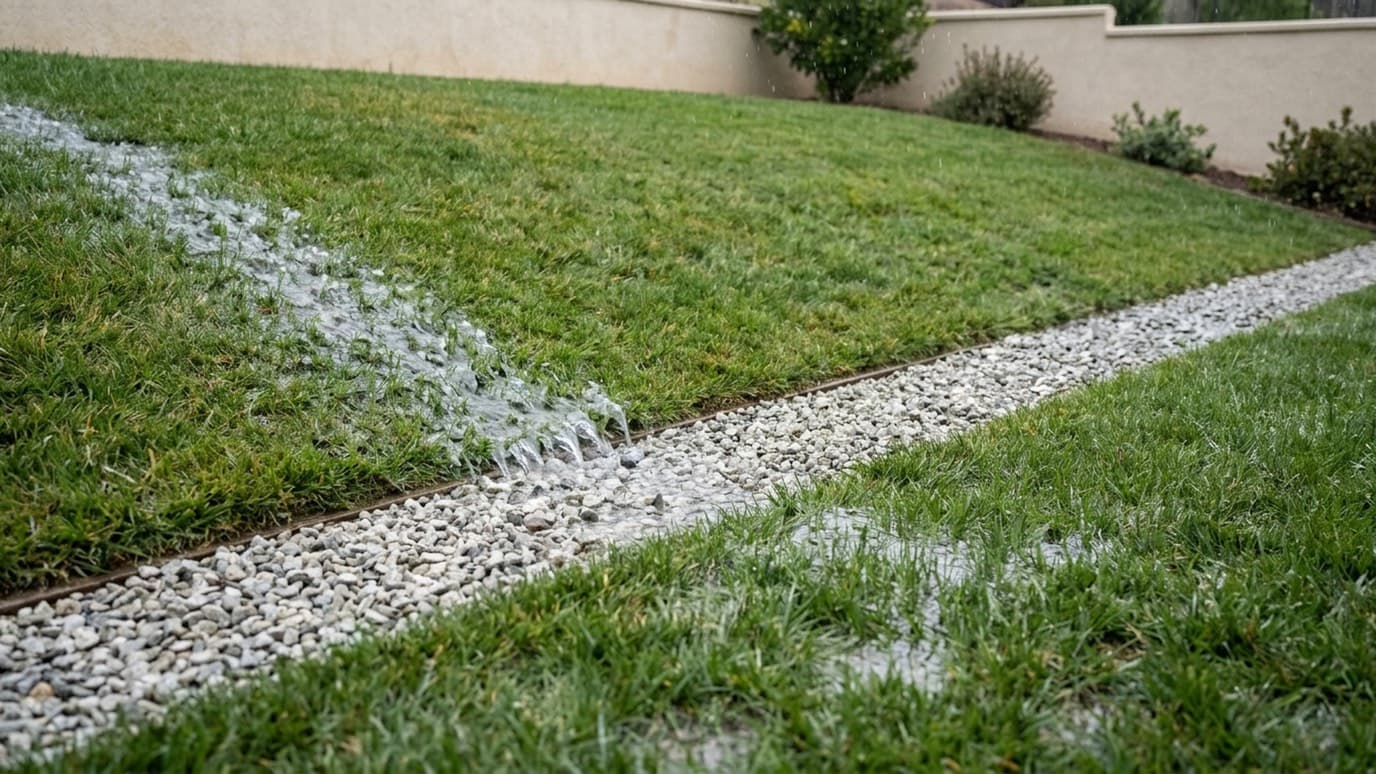
Landscape drainage repair in Winchester works differently from the incorporated cities around it. Winchester is unincorporated county ground, much of the valley floor is flat, and groundwater has been measured close to the surface. Those three facts decide which fix suits a lot, and which common fixes are a poor bet here. This guide sets them out. If you already know you need a drain, the page for French drain installation in Winchester is the place to start.
Standing water on your Winchester lot? Describe where it collects and what the ground is like.
Winchester is county ground
Winchester is a community in unincorporated Riverside County, which the County's Harvest Valley/Winchester Area Plan covers, and the Census Bureau counts it as a census-designated place, not an incorporated city. There is no city code to look up. County instruments apply instead.
That matters for the paperwork. Riverside County Building and Safety lists the work that needs a grading permit, including grading, excavation and earthwork. That list was read in August and not re-checked for this page, so confirm what applies to a specific repair with the County before work starts. The same is true of any work on a frontage along State Route 79: Caltrans defines encroachments to include structures in state highway right of way and lists drainage facilities among the improvements that need a permit.
Flat ground and shallow groundwater
The U.S. Geological Survey's study of the Winchester subbasin describes about 12 of its 20 square miles as relatively level valley floor. On flat ground, standing water is usually a problem of getting water to a place where it can leave, not of stopping water that is flowing in from above. That is reasoning from the terrain, not a finding about any lot.
The same study measured depth to water in 1994 and 1995 at 6 to 72 feet, and generally less than 11 feet through most of the central part. Those are measurements from three decades ago and say nothing about the water level today. A 2021 geotechnical investigation at Willard Street and State Highway 79 estimated high groundwater at 10 feet below the surface and found water at about 15 and 13 feet in two borings. It also recorded percolation tests of 30 and 60 minutes per inch, which it converted to infiltration rates of 0.2 and 0.1 inch per hour. That is one site, not the whole community.
What that does to the usual fixes
Two county rules put numbers on the limits. The County's low impact development handbook calls for 10 feet between the bottom of an infiltration facility and the historic high groundwater mark, and its infiltration testing guidance applies a factor of safety of 3 to percolation test results. On a lot where groundwater sits near 10 feet and the soil drains slowly, a dry well or other buried infiltration is a weak default. That conclusion is reasoning from those numbers, and a site test is what settles it for a particular lot.
If the property is on septic, the County's onsite wastewater program (the November 2022 draft on the State Water Board's site) requires at least 5 feet of undisturbed soil between groundwater and the bottom of a leach trench, and holds septic tanks and leach lines 15 feet from a drainage course. A deep French drain trench and a septic field compete for the same ground.
Which fix fits which lot
| What the lot looks like | The usual fit | What rules it out |
|---|---|---|
| Flat yard, water stands after rain, a street or swale lower than the yard | Regrading to produce fall to an outlet | No lower point to send the water to |
| Soft ground that stays wet after the surface has drained | A subsurface drain, see French drain installation, after the surface is corrected | Groundwater too shallow for the trench depth, or a septic field in the way |
| Roof water landing at the wall | Downspout drainage carried to an outlet | Relying on the ground to take it in |
| A frontage on State Route 79 | Work planned around the encroachment permit | An outlet that would discharge into the highway right of way |
| A street with a curb | The County's standard drawing for a private drain through the curb, which is one of its road standards | Any connection that has not been permitted |
The County's road standards list Standard 310, Private Drain Through Curb, and Standards 308 and 309 for a curb outlet drain and an under-sidewalk drain. Whether one applies to a particular street is a question for the County.
Older homes and new tracts fail differently
The Census Bureau's 2020 to 2024 estimates count about 1,483 housing units in Winchester, with a wide margin of error. Of those, 408 were built in the 1980s, 296 between 2010 and 2019 and 314 in 2020 or later. Two-thirds of the housing is therefore either 1980s or recent, and a drainage repair on one is a different job from a repair on the other: an older lot may have had its fall change over decades, while a recent tract was graded to a plan that something later defeated. That is reasoning from the housing mix, not a finding about any street.
Not sure which fix your Winchester yard needs? Describe the lot and where the water goes.
Get yard drainage help in Winchester
These pages cover the work: yard and landscape drainage in Winchester, French drain installation in Winchester, grading and drainage correction in Winchester and downspout and gutter drainage in Winchester. For a wider look at the causes of standing water, see the yard flooding guide.
FAQ
Do I need a permit for yard drainage work in Winchester?
It depends on the work. Because Winchester is unincorporated, the County is the permitting body and not a city. County Building and Safety lists grading and excavation among the work that needs a grading permit, and work on a State Route 79 frontage involves Caltrans. Ask the County before digging.
Can I use a dry well in Winchester?
Often not as the main solution. The County asks for 10 feet between an infiltration facility and the historic high groundwater mark, and groundwater in parts of the area has been measured or estimated near that depth, with slow percolation at the one site that was tested. A site test decides it.
How deep can a French drain go in Winchester?
Only as deep as groundwater and any septic field allow. Groundwater has been measured under 11 feet through much of the central subbasin in 1994 and 1995, and the County requires 5 feet of undisturbed soil under a leach trench. That points toward a shallow run to a real outlet, which is reasoning from those limits and not a design for any lot.