
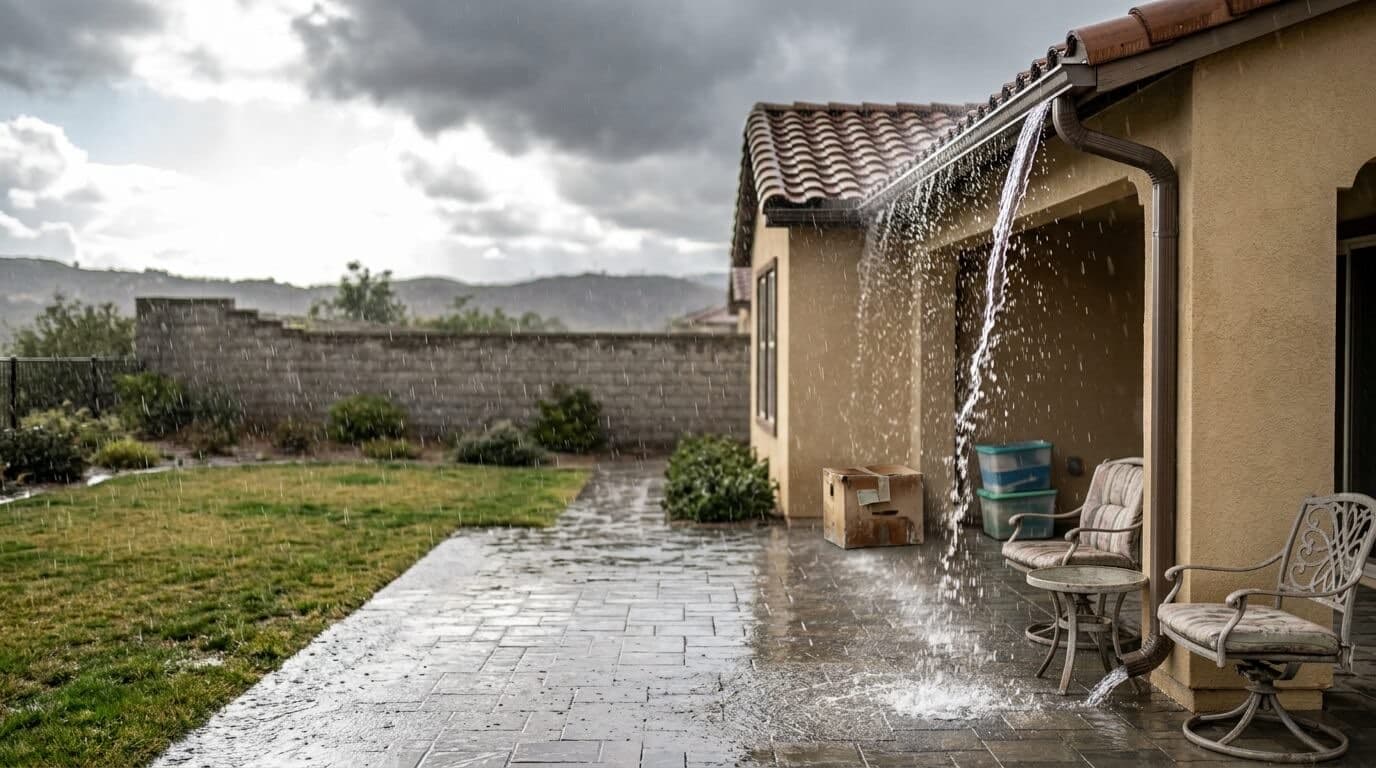
A wetter-than-normal winter is favored for Southern California. The work that keeps that water out of a house is mostly one dry afternoon with a hose, a tape measure and a ladder, and it is far easier to do in October than during the first storm. This page is the checklist, and what to do about whatever it turns up.
The forecast behind it, briefly: NOAA's Climate Prediction Center said on October 8 that a strong-to-very strong El Niño is likely to hold through March, at better than an 83 percent chance, and its October 15 seasonal outlook favors above-normal precipitation for much of California this winter. Those are odds, not inches of rain. How much they actually promise is at the end of this page, including the strong El Niño winter that brought California almost nothing.
Want the yard checked before the rain? Describe where the water collects now.
Seven checks to run before the first storm
You can do all of these yourself. If you only have an hour, do the first two: roof water is the most concentrated water a yard receives, and Riverside County's grading notes ask that concentrated drainage be contained on site or sent to an approved drainage facility.
- Clear the gutters and every place a downspout empties. The county's flood guidance notes that leaves and broken limbs clog drainage and make water back up.
- Look at where each downspout ends. If it empties at the foundation, or onto a slab that tips toward the house, the roof water is being delivered to the wall. The fix is an extension or a buried line, which the Temecula downspout page describes. The downspout drainage guide compares the options.
- Check the grade along the foundation. The model residential code (section R401.3) calls for ground to fall at least 6 inches in the first 10 feet away from the wall, with paved surfaces within 10 feet sloping at least 2 percent. The InterNACHI inspector guide walks through it. A quick test: set a 4-foot level on the ground at the wall and measure the gap at the far end. About 2.4 inches means a 6-inch fall over 10 feet. Where a fence, wall or slope prevents that, the code expects a drain or swale. How the code applies to a particular lot is a question for the City of Temecula's building department. If water is already standing at the wall, this guide covers what to do about it.
- Find where water leaves the yard. Walk from the lowest spot to the street or the nearest drainage way. Slabs poured to the fence line, planters, raised beds and gate thresholds are the usual blockages. A Menifee article lays this check out in more detail.
- Run the drains you already have. Put a hose in each catch basin or pop-up emitter for several minutes and watch both ends. A drain that backs up under a hose will not manage a storm.
- Photograph the yard during the first real rain. Pooling and flow direction are hard to reconstruct afterward, and a few phone pictures settle arguments about where the water goes.
- Get sandbags before you need them. The City of Temecula provides up to 10 sandbags to residents at no charge before or during any storm. Pick them up at a Temecula fire station and fill them at the city sand lot at Ynez Road and Santiago. Bring a shovel. The county notes that many fire stations keep a supply and that hardware stores sell them. In other cities, ask the city or the local fire station what they offer.
What to do about what the checks turn up
If the roof water lands at the wall, the downspouts are the problem, and that is the cheapest of these to fix. If the ground falls toward the house, or there is a low spot against the foundation, it needs regrading. If the yard stays wet after the surface has drained, or a wall or slope seeps, the water is moving through the ground, and the usual answer is a French drain. Soils on Temecula's uplands and foothills drain slowly, so a drain there has to carry water to an outlet and not let it soak away. The Temecula French drain article covers the soil side of that.
A driveway that slopes toward the garage door is a separate case, written up in the Lake Elsinore driveway flooding article. Patios and pool decks have their own version of the problem, covered in the Murrieta hardscape drainage article.
What a wet stretch has already done in this valley
Riverside County's flood response plan describes the common thread in local flooding as short, intense storms, and lists El Niño among the main causes alongside atmospheric rivers and tropical storms. Its list of notable events includes January 1993, when at least 10 inches of rain fell over two weeks in western Riverside County. Seven people died. Murrieta Creek ran at a record flow and overflowed, and Old Town Temecula flooded to depths of up to 5 feet. The plan does not describe that winter as an El Niño winter, which is the point: the valley does not need an El Niño to put water where it does not belong.
Water already finding its way to the house? Describe where it goes.
How much the forecast actually promises
Less than the headlines suggest. NOAA's October 15 outlook favors a wet winter for much of California, but it attaches no percentage to the state and says the odds here are lower than in the Southeast, where some areas pass 70 percent, because the forecast models disagree more about the West. A regional lean is not a number for any one yard in Murrieta or Menifee, and it is not inches of rain.
The two most recent very strong El Niño winters went opposite ways. In 1997-98 the rain arrived: NOAA's National Climatic Data Center reported a series of California storms in February 1998 linked in part to El Niño, with 17 storm-related deaths for the winter, 35 counties declared federal disaster areas, and 9.49 inches in the city of Riverside that month, an all-time February record. In 2015-16 it did not: researchers at Scripps Institution of Oceanography found that earlier strong El Niño years brought California 150 percent of average precipitation or more, while 2015-16 came in below even the average for years with no El Niño, because conditions elsewhere in the Pacific steered the storms north. Forecasters cited by CalMatters say the same about atmospheric rivers, the storms that deliver the heaviest rain: whether one lands on Southern California does not follow neatly from the El Niño.
Which is the practical case for the checklist rather than against it. Every item on it is worth doing in a normal winter, and none of it is wasted if the rain never comes.
Yard drainage help by city
The same causes show up across the valley, and the work depends on the lot. Yard drainage pages by city: Temecula, Murrieta, Menifee, Wildomar, Lake Elsinore, French Valley, Winchester, Homeland, Lakeland Village, Fallbrook and De Luz. For the services themselves, see yard and landscape drainage, French drain installation, grading and drainage correction and downspout and gutter drainage.
This page uses the NOAA figures issued on October 8 and October 15, 2026. NOAA updates the ENSO discussion on November 12 and the seasonal outlook on November 19.