
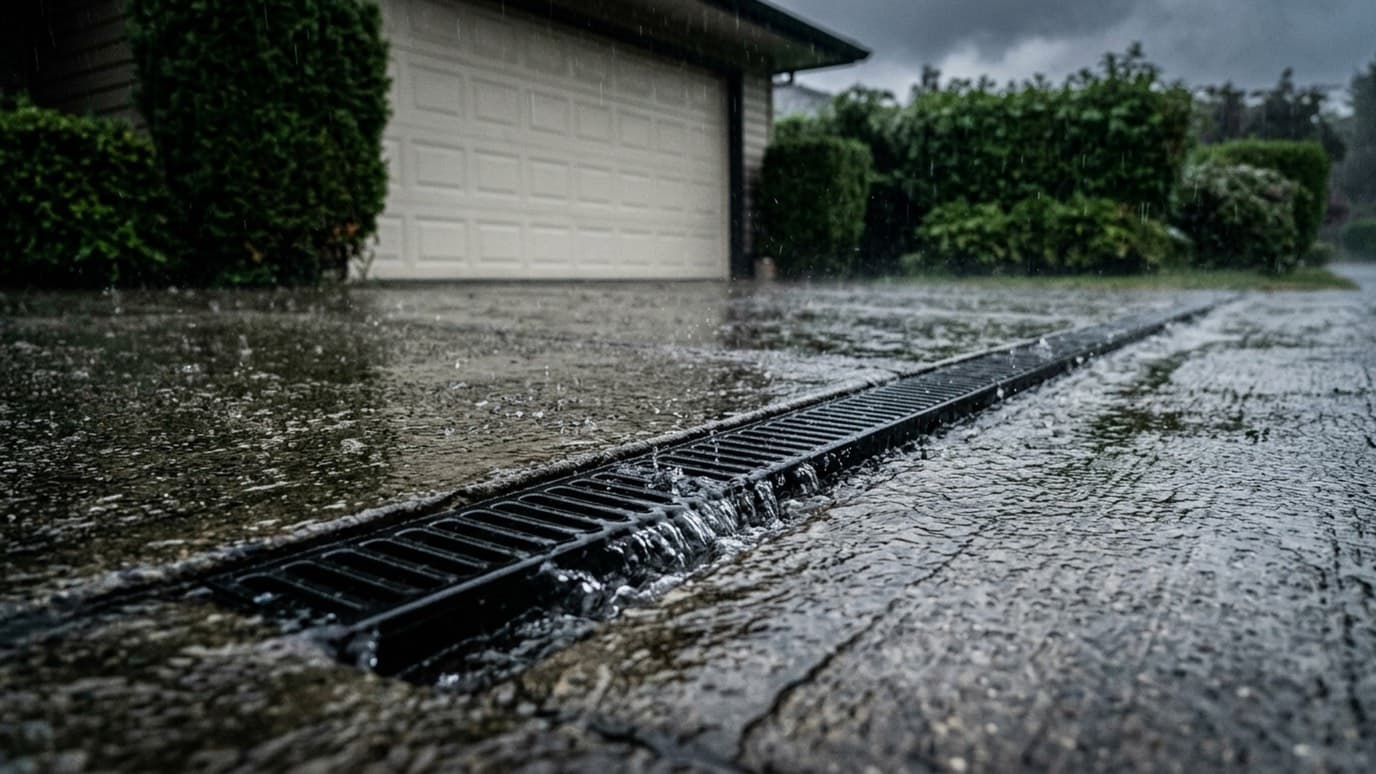
Water gets into a garage because the driveway delivers it there. Concrete takes none of the rain that lands on it, so the whole surface sheds toward its low edge, and when the low edge is the garage door, that is where the water goes. Stopping it means doing three things in order: catch the water before it reaches the door, make sure the ground leads away from the door, and give the water somewhere it is allowed to go. This guide takes them in the order the water moves.
Driveway water heading for the garage? Describe where it comes from and where it ends up.
How the water reaches the garage
Rain on a driveway does not run in a stream. It moves as a thin sheet across the whole width of the pavement, toward whatever edge is lowest. If the driveway falls toward the house, the sheet reaches the garage door as one broad flow, and the slab behind the door is the first thing lower than the driveway.
That is the reverse of how a new house is meant to be graded. The California codes, as the City of Hemet's engineering division quotes them, call for paved surfaces within 10 feet of the foundation to slope at least 2 percent away from the building. The Rhode Island Department of Environmental Management makes the same point from the other side in its sheet on driveway drains: where a driveway slopes toward the home, a drain at the foot of the slope reduces the risk of flooding into the foundation or basement.
Key takeaway: The flood is decided by which way the pavement falls. Everything below either intercepts that flow or changes it.
What to do during the storm
Staying safe comes before stopping the water. The National Weather Service says that 6 inches of fast-moving water can knock over an adult and that 12 inches of rushing water can carry away most cars. A driveway sheet is rarely that deep, but water running toward a street or a flooded road may be, and depth is hard to judge.
If water is already inside the garage, treat it as electrified until shown otherwise. FEMA's guidance on returning home after a flood says to turn the electricity off only if it is safe to do so, never to touch electrical equipment that is wet or while standing in water, and to remember that downed or underground lines can charge floodwater. Do not wade in to reach a panel. Moving a car out before the water arrives is a reasonable precaution, but not if it means driving through moving water.
Channel drains
A channel drain, also called a trench drain, is a slot or grate set across a paved surface. The Rhode Island sheet describes it as a slot inlet that catches rainwater sheet flow from an impervious driveway and moves it below ground. It is cut into the existing pavement at the foot of the slope, normally with a removable grate or a gravel-filled slot, and it connects to a pipe that carries the water to a safe place away from the house or the road.
Two things decide whether it works. The first is placement: because the water moves as a sheet, the drain has to span the width of the flow, and a short drain at one corner lets the rest of the sheet go past. The second is capacity. A grate takes in only so much, and in a storm heavier than it was sized for, water will pass over it. Both are reasoning about how a drain behaves, not figures from a source, so a particular driveway needs to be looked at, not assumed.
Water reaching your garage when it rains? Describe where it comes from and where it ends up.
Catch basins
A catch basin collects water at a point and not across a line. The U.S. EPA describes storm drain inlets, curb inlets and catch basins as inlets to a storm drain system. On a driveway, one fits a single low spot, such as the corner where two slopes meet or the bottom of a swale. It needs a pipe leaving it, and it does less when the water arrives across the whole apron than a channel does. A basin is also a small opening serving a lot of paved area, which is why it clogs easily.
Grading
A drain collects water that is already coming. Grading changes where the water goes. If the driveway or the ground at the garage falls toward the building, no drain will fully offset that, and the lasting fix is to reverse the fall so that water leaves the door and not enters it. The residential code expects the same thing where it can be done, and says that where lot lines, walls, slopes or other barriers prevent it, drains or swales should be built to carry water away from the structure.
Reversing the fall on a driveway usually means working on the pavement itself, which is why a drain is often the practical choice. If the water arrives from a slope above the driveway and not from the driveway's own surface, the work moves uphill, and slope drainage covers it. Where the fall can be restored, regrading does.
The outlet
Collecting the water solves half of it. Every drain, channel or basin needs somewhere lawful to put what it collects, and that is where driveway projects most often go wrong.
The model residential code asks that surface drainage go to a storm sewer or other approved point of collection that does not create a hazard. Riverside County's grading notes say excess or concentrated drainage must be contained on site or directed to an approved drainage facility, with erosion at the discharge prevented. The county's stormwater ordinance, which covers the unincorporated areas, defines an illicit connection as any physical connection to the storm drain system that the County, the Flood Control District or another appropriate public agency has not permitted. A lot inside a city is likely to answer to the city's own rules, so what is allowed at a given curb is a question for the building or public works department.
The usual choices are a lower part of the property, a permitted connection at the curb, or a buried infiltration area. The Rhode Island sheet describes sending drain water to a vegetated infiltration area a safe distance from the house or road, with a sediment trap between the pipe and that area. Whether the ground on a lot will actually take in the water is a separate question, and slow-draining soil will not take in much. On a Lake Elsinore lot the legal place to send the water, and the conditions that decide which fix fits, are set out in how to stop driveway and garage flooding in Lake Elsinore.
Maintenance
A drain that is full does nothing. The Rhode Island sheet says a trench drain needs regular inspection and removal of debris and sediment, with grates designed to be lifted out and cleaned. The EPA notes that small inlets serving paved areas can fill with sediment, debris and trash quickly. Clearing leaves and grit from a grate before the first storm of the season, and again during a long wet spell, is the simplest maintenance on the whole system.
Get it fixed
If water is already reaching the garage, these pages cover the work: yard and landscape drainage, grading and drainage correction, retaining wall and slope drainage and French drain installation.
FAQ
Will a channel drain stop my garage from flooding?
Often, but only if three things hold: it spans the flow, it is not overwhelmed by the storm, and it has an outlet. A drain that is too short, too small or connected to nowhere will not keep water out of the garage.
Do I need a permit to cut the driveway or connect to the street?
It depends on what is being built and where. Cutting a curb or connecting to a storm drain involves the city or the County, and Riverside County's ordinance treats an unpermitted connection to the storm drain system as an illicit connection. The permitting office for the lot is the one to ask before anything is cut.
What if the water comes from a slope or a neighbor's yard, not my driveway?
Then a drain at the garage is the second line of defense, not the first. Water arriving from above needs to be intercepted before it reaches the apron, which is the work covered under slope drainage. If the garage floods but the foundation wall is also wet, the two questions are separate, and the foundation guide covers the second.