
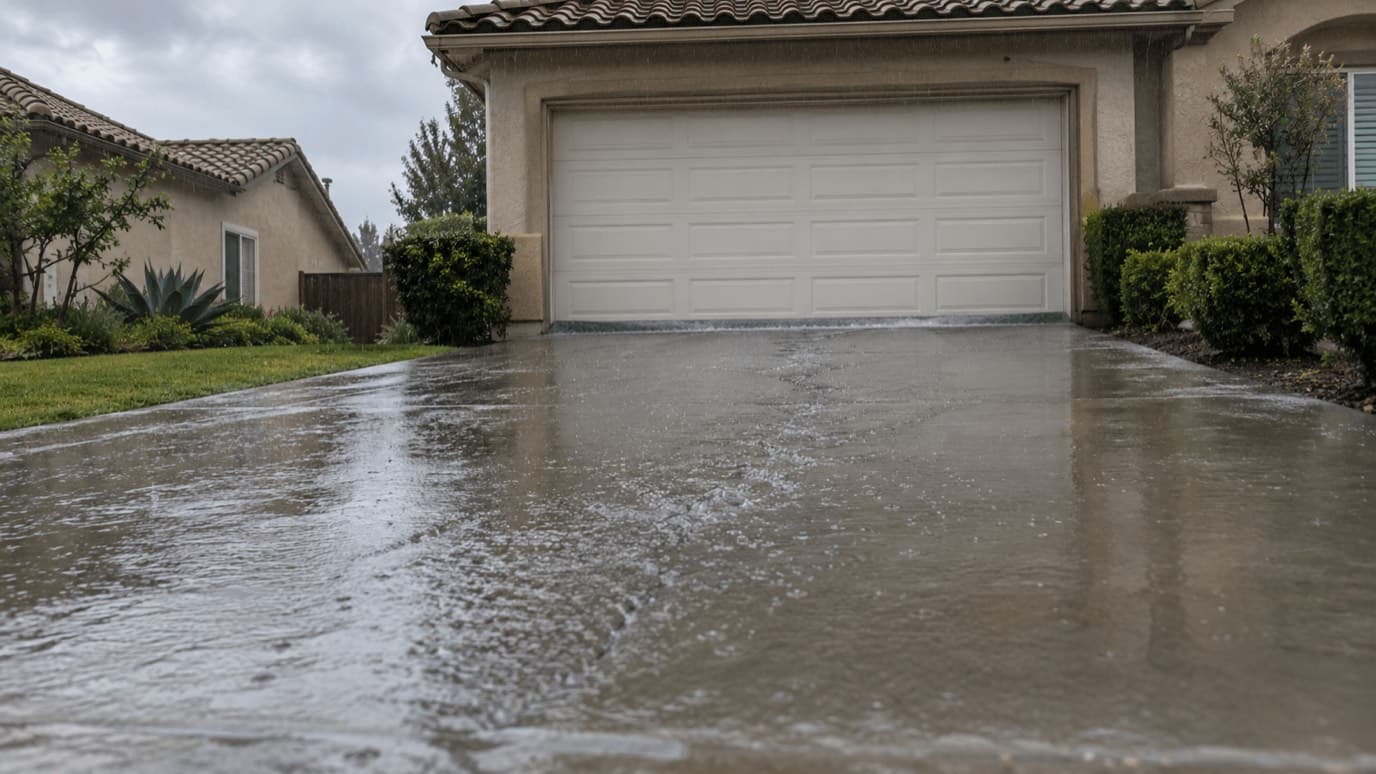
Water in a garage almost never starts at the garage. It starts higher up — at the top of the driveway, or at the Lake Elsinore street the driveway drains onto — and the slab is just the lowest floor in its path. Stopping it means working back up that path to the point where the water is decided: the pitch of the apron, the height of the street, and the one permitted place the water can go once it is collected. Each of those is documented for Lake Elsinore, so the fix here is more specific than "improve the drainage." This works through them in the order the water moves.
A strong El Niño is forecast for this winter. The El Niño winter guide covers what the forecast says and what to check before the rain, driveway included.
Driveway or garage flooding in Lake Elsinore? Describe where the water enters.
Why a Lake Elsinore driveway sends water at the garage
A driveway is a ramp. On most lots it pitches down from the street to a garage set at or below the surrounding grade, so the same slope that lets a car climb it carries rain straight to the lowest point — the garage threshold.
What makes this a Lake Elsinore problem is the street the apron drains onto. Lake Elsinore's drainage standards fix what its streets are built to handle:
- A 10-year storm is designed to be carried between the tops of the curbs.
- A 25-year storm is designed to be carried within the street right-of-way.
In plain terms, a Lake Elsinore street gutter is engineered to fill toward curb height in a real storm before the storm-drain system takes over. A driveway whose low end meets that curb is not draining to a dry gutter; at the peak it can be draining against a gutter already near curb-full. That is why the fixes that work intercept water on the apron before it reaches the curb line. The load is seasonal, not constant: the Elsinore climate normal is 11.65 inches a year, and close to nine-tenths of it falls November through April — a three-month load on a surface that absorbs none of it.
Key takeaway: A Lake Elsinore driveway floods at the garage because it drains to a street gutter the city designs to fill toward curb height in a storm. A fix that intercepts water on the apron beats one that relies on the gutter to take it.
Is it your water, or the neighborhood's?
Before choosing a fix, settle one question: is the water on the apron only what fell on it, or is it arriving from higher ground? The answer changes the fix.
The City lists the drainage courses that carry flood water through Lake Elsinore — among them Arroyo del Toro, Leach Canyon and Lime Street Channels, McVicker Canyon, Ortega Wash, Rice Canyon and Wasson Canyon Creek — and its General Plan hydrology report records water thrown off by McVicker Canyon spreading as sheet flow across the alluvial fan at the canyon's mouth. Sheet flow is a broad, shallow film rather than a defined channel, and a driveway in its path takes a share of it no matter how well the apron is graded.
The test is timing and direction:
- Your own runoff appears only during the storm and enters from the street or the top of the apron.
- Off-lot water arrives across a side yard or from an uphill property, or keeps coming after the rain has eased.
A driveway drain sized only for the apron will be overrun by off-lot water, so this is the first thing an assessment settles.
Key takeaway: If water crosses the driveway from the street, solve it at the street end of the apron. If it enters from uphill or a side yard, intercept it before it reaches the driveway. A drain at the garage door alone may not handle the whole contributing flow.
What to watch during a storm — safely
The most useful thing you can do costs nothing: watch the driveway in a real storm, from a dry spot well clear of the street and out of moving water. Note three things:
- Where water first crosses onto the apron.
- How deep it stands at the garage threshold at the peak.
- Where it leaves.
A phone photo at the height of the storm records all three better than memory.
Each observation sizes a different part of the fix: the entry point decides where interception goes, the depth at the door decides how much has to be intercepted, and the exit decides whether an outlet already exists or has to be created. The general storm-safety rules — never walk or drive through moving water, stay clear of the street at peak flow — are covered in the regional guide; here the point is narrower: the storm is the one time the driveway shows you exactly where it fails.
Key takeaway: Three observations during one storm — entry, depth at the door, and exit — are what an accurate fix is designed around. Record them from a safe, dry vantage.
The garage threshold and the grade meant to protect it
The garage door's first line of defense is the grade in front of it, and Lake Elsinore builds to a specific standard for it. The City's grading notes require finish grade to fall away from exterior walls at not less than half an inch per foot for at least the first three feet, then at a minimum of one percent to the flow line of a swale. Around a garage, that outward half-inch-per-foot apron is what turns water away from the slab before it reaches the door.
The usual failure is that the grade existed at construction and has since been undone:
- A driveway resurfaced to a higher level.
- A raised planter or path laid across the fall.
- A slab that has settled and now tips inward.
Each cancels the outward pitch and turns the three feet in front of the garage into a collecting shelf. Restoring that fall — the work of grading and drainage correction — or intercepting the water where the fall can no longer be recovered, is often the whole fix on a flat lot, and it is a separate question from how the street below is behaving.
Key takeaway: Lake Elsinore's finish-grade rule — a half-inch of fall for each of the first three feet out from the wall — is what keeps water off the garage slab. Added hardscape or a settled slab commonly cancels it.
Where the water is allowed to go
Once water is collected at the garage, it has to go somewhere Lake Elsinore permits — and the permitted route is a named detail, not a free choice. In most cases a driveway's collected water is carried through a permitted curb outlet to the street gutter, and that curb work needs city approval under a county standard detail.
Because the city adopted Riverside County's road improvement standards as its own, the outlet is a county standard drawing:
- Standard Drawing No. 310, "Private Drain Through Curb."
- Standard Drawing No. 308, "Curb Outlet Drain."
Both govern how a private line crosses the curb face to the gutter. Cutting or building into a Lake Elsinore curb is work in the public right-of-way, so the city requires an encroachment permit from its administrative authority before an encroachment is established in a public place.
A driveway dry well is not an automatic alternative, and a published threshold is why. The regional Water Quality Management Plan guidance sets the limits:
- Infiltration devices are not used where a site's measured infiltration rate is below 1.6 inches per hour.
- They are excluded where the bottom of the device would sit less than ten feet above the historic high groundwater mark.
- A site-specific infiltration test and groundwater check should come before a dry well is chosen.
On much of the ground in Lake Elsinore that rules a dry well out before it is dug, which is why a permitted curb outlet — not a soakaway — is the usual endpoint.
Key takeaway: A driveway drain in Lake Elsinore usually discharges through a permitted curb outlet built to Riverside County Standard Drawing No. 310, under a city encroachment permit. A dry well is an option only where a measured infiltration test clears the regional WQMP thresholds.
Which fix a given driveway calls for
The right device follows from what the apron shows and the outlet the lot has — not from a product picked in advance. How each device is built — how a driveway channel drain is set across an apron, how a catch basin is sized — is covered in the regional guide; what is local is which one the condition calls for.
| What the driveway shows | Indicated approach | What would change it |
|---|---|---|
| Water crosses the whole width at the street end and ponds at the door | A channel drain across the apron, discharging through the curb per County Standard Drawing No. 310 | No fall to the curb line; then interception higher up the apron |
| One low spot mid-apron holds water after the rest drains | Point collection at the low spot into a piped run to the curb outlet | Outlet elevation too high to give the pipe fall; the grade question reopens |
| The three feet in front of the door pitch inward toward the slab | Restore the finish grade away from the wall; add a drain only if the fall cannot be recovered | Added hardscape fixing the level; then a channel drain at the door |
| Water arrives across a side yard or from uphill, not just off the apron | Intercept above the apron first; the apron drain is secondary | It proves to be only apron runoff after all; then treat the apron alone |
| The intended fix ends in a buried dry well | Reconsider — infiltration is limited under the regional WQMP thresholds | A site infiltration test showing a usable rate and clearance above groundwater |
The table keys on the driveway's condition and its outlet, not on a product. Two Lake Elsinore garages taking water at the door can need different work because the apron and the available curb outlet differ.
How a channel drain, a catch basin or a trench drain across the apron is actually built and maintained is covered, without the Lake Elsinore specifics, in stopping driveway and garage flooding during heavy rain.
Not sure which fix your Lake Elsinore driveway needs? Talk it through.
The steep-driveway case on the west-side hillsides
On the west-side hillsides above the valley the geometry is sharper, and interception above the apron matters more than a drain at the door. The City's General Plan describes Country Club Heights as a district of steep slopes — many lots over 25 percent grade, on parcels from a few hundred square feet to several acres, reached by roads ranging from unpaved tracks to single-lane pavement under twenty feet wide wherever the grade tops ten percent. A driveway on that ground can fall a full storey from the road to the garage, arriving at the door with speed a flat lot never builds.
The fix is to catch the water before the steepest part of the run, so the drain at the door handles a remainder rather than the whole hillside's contribution. Where the runoff is tied up with slope stability, bare-slope erosion, or burn-area debris after a fire, it stops being only a driveway question — that larger picture is its own subject, covered in the Lake Elsinore guide to hillsides, runoff and erosion. For a driveway that simply pitches too hard at the garage, the principle is the flat-lot one: settle the outlet first, intercept before the low point, keep the water off the slab.
Key takeaway: On steep Country Club Heights driveways, intercept runoff above the apron so the drain at the garage handles only what is left. Slope stability, erosion and post-fire debris are a separate subject.
Get yard drainage help in Lake Elsinore
If the water on your Lake Elsinore lot is already a problem, these pages cover the work: yard and landscape drainage in Lake Elsinore, French drain installation in Lake Elsinore, grading and drainage correction in Lake Elsinore and downspout and gutter drainage in Lake Elsinore.
FAQ
Why does my garage flood in Lake Elsinore when it hardly rains here?
The rain that does fall arrives concentrated and on a surface that absorbs none of it. The Elsinore climate normal is 11.65 inches a year, but roughly 90 percent of it falls November through April, and the City names October through April as its season of greatest flood potential. A driveway pours whatever lands on it straight down to the garage at the bottom no matter the month, so a handful of winter storms set the problem, not the modest yearly figure.
Where is a driveway drain allowed to discharge in Lake Elsinore?
In most cases through a permitted curb outlet to the street gutter, built to a county standard detail and approved by the city — not released at an arbitrary point in the public right-of-way.
- The city adopted Riverside County's road standards, and the county's curb-outlet details are Drawing No. 310, "Private Drain Through Curb," and No. 308, "Curb Outlet Drain."
- Curb work sits in the public right-of-way, so it needs a city encroachment permit before it begins.
- Where a curb outlet is not workable, another approved drainage path has to be found; the outlet is settled before the drain is dug.
Can a driveway dry well work in Lake Elsinore?
A dry well is not automatically suitable for driveway runoff. The regional Water Quality Management Plan guidance sets the conditions:
- Infiltration devices are not used where a site's measured infiltration rate is below 1.6 inches per hour.
- They are excluded where the bottom of the device would sit less than ten feet above the historic high groundwater mark.
- A site-specific infiltration test and groundwater evaluation should happen before a dry well is selected.
- Where infiltration is not feasible, a permitted curb outlet or another approved drainage path is used instead.
The street floods too — is that why my driveway backs up?
It is part of it. Lake Elsinore's drainage standards design streets so a 10-year storm is carried between the tops of the curbs and a 25-year storm within the right-of-way, meaning the street gutter is built to fill toward curb height in a heavy storm before the storm-drain system takes over. A driveway meeting that curb is draining against a gutter that may already be near curb-full, so the fixes that hold intercept water on the apron rather than relying on the gutter to take it.
Is water in my garage a foundation problem?
Not necessarily. Water reaching a garage slab down the driveway is a surface-water and grade question — where the apron pitches and where the water can exit. Whether standing water against a foundation is doing structural harm is a separate diagnosis, covered in the guide to water pooling against a house foundation. Keeping the driveway water off the slab in the first place is the surface question this article addresses.