
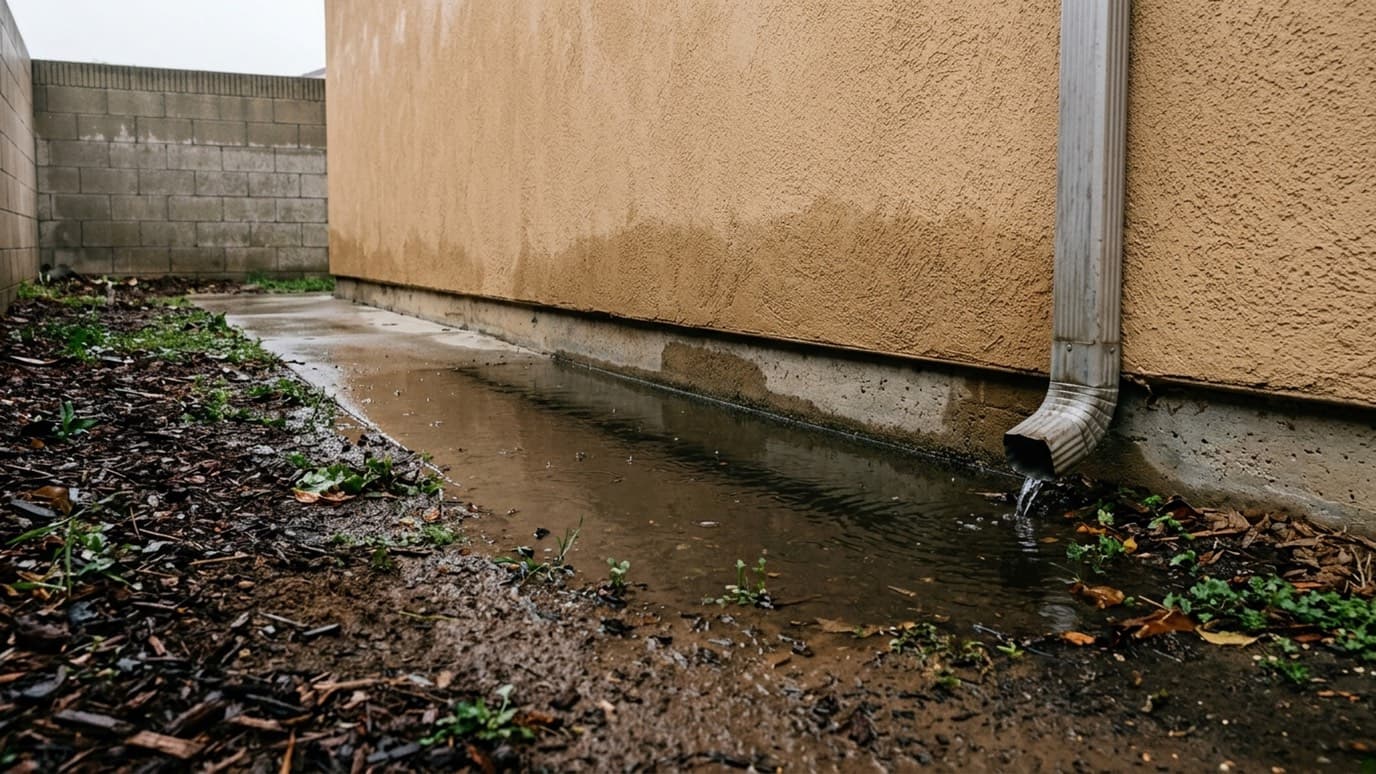
Water that stands against the base of a wall raises two questions at once. The first is where it comes from and how to send it somewhere else. The second is whether it has already done anything to the structure. This guide handles the first. It also marks where the second begins, because the two are answered by different people. Water standing elsewhere in the yard has its own list of causes, set out in the yard flooding diagnosis guide.
Water standing against your house? Describe where it collects.
What pooling at the wall usually means
Rain that lands on a roof, a patio or a slope has to go somewhere. When it collects against the foundation, the cause is usually one of three things: a downspout that ends at the wall, ground that tips toward the house, or a low spot where the fall has been lost. That is a reading of how water behaves and not a finding about any one house, so the way to confirm it is to watch. Water that reaches the wall during the storm and drains away soon after points to roof water or surface flow. Water that is still there long after the rain has stopped points to a low spot, a flat grade or no way out.
The ground in this valley raises the stakes. The USDA's soil description for the Auld series, mapped in Southern California foothills and uplands, lists surface cracks and slickensides, the marks of clay that swells when wet and shrinks when dry. Its description of the Murrieta series, found a few miles west of Temecula, gives 35 to 50 percent clay and slow permeability, and Murrieta's General Plan records expansive clays in the Pauba formation. Water that sits on soil like that has little way to soak in, and it keeps the ground at the wall wet.
Three checks to run first
- Watch where the water comes from. Go out during or just after a rain and note where it enters the area, along the ground or from a downspout, and where it stops.
- Look at where each downspout ends. Roof water is the most concentrated water a yard receives. Riverside County's grading notes say excess or concentrated drainage must be contained on site or directed to an approved drainage facility, and the model residential code asks that surface drainage go to a storm sewer or other approved point of collection that does not create a hazard.
- Measure the grade. The ground next to the wall should fall away from it. The 4-foot-level method is laid out in the El Niño preparation guide. What to measure against is the next section.
Water standing against your foundation? Describe where it collects and where the downspouts end.
What the grade should be
The numbers come from the 2022 California codes, as the City of Hemet's engineering division quotes them. The California Building Code asks for ground next to the foundation to slope away at 1 unit in 20, a 5 percent slope, for at least 10 feet. The California Residential Code asks the grade to fall at least 6 inches within the first 10 feet. Those are the same figure written two ways, since 6 inches over 10 feet is 5 percent. Riverside County's grading notes, in note 16, say the same thing for county grading work. Paved surfaces within 10 feet of the wall should slope at least 2 percent away from it.
Two limits are worth knowing. These are the standards a lot is graded to when it is built, so they are a useful yardstick for an existing yard, not an obligation that applies to it. And the building code itself allows the slope to drop to 2 percent where climate or soil conditions warrant, so a yard with less than 5 percent is not automatically wrong. What is wrong is ground that falls toward the wall.
If roof water is the cause
Fix the delivery before the ground. A downspout that ends at the wall puts a whole roof's runoff in one spot. The remedy is to carry that water away to somewhere it is allowed to go, through an extension, a buried line or an emitter, which is the work described on the downspout drainage page. The options are compared in the downspout drainage guide. The outlet matters as much as the pipe. A line that ends at a neighbor's wall, or at a spot that floods in turn, only moves the pooling.
If the grade has gone flat or reversed
Fall tends to disappear slowly, as soil settles and planters, slabs and walls are added. Where it has, regrading restores it. Where lot lines, walls or slopes make 6 inches of fall in 10 feet impossible, the residential code says drains or swales should be built to carry water away from the structure, and the building code asks a swale within 10 feet of the foundation to slope at least 2 percent.
If the water has no way to leave
Sometimes the fall cannot be recovered, because a fence, a wall or the lot itself is in the way. Then the water has to be collected and piped to an outlet. A surface drain gathers water that arrives across the ground. A subsurface drain gathers water moving through the soil. Which one fits depends on whether the water is arriving on top of the ground or in it, and either one needs a legal place to discharge. A drain with no outlet is a longer puddle. The broader menu of options is on the yard drainage page.
Where drainage ends and structure begins
Drainage work moves water. It does not tell you whether a foundation has moved. The U.S. Department of Housing and Urban Development's inspection standard gives one reference point. It counts a foundation crack as a deficiency at a width of a quarter inch or more and a length of 12 inches or more, and it names cracks in walls, doors that no longer work and unlevel floors or windows as the things to look for. It lists water infiltrating the foundation as a separate deficiency. That standard is for inspecting HUD-assisted housing and is not an engineering diagnosis, but the signs are a sensible prompt.
| What you see | What it most likely is | Next step |
|---|---|---|
| Water at the wall during rain that drains soon after | Roof water or surface flow | Check the downspouts and the grade |
| Water standing long after the rain stops | A low spot, a flat grade or no outlet | Restore the fall, or collect it and pipe it to an outlet |
| A crack a quarter inch wide and 12 inches long or more, or doors, floors or windows that have changed | Possibly a structural question | Measure and photograph it, then have a licensed professional such as a structural engineer assess it |
| Water coming through the foundation | Not a yard-surface problem on its own | Same as above |
If the signs in the last two rows are present, get the structure looked at before or alongside any drainage work. Moving the water away will not tell you what has already happened.
Before you dig
Any regrading or drain means digging. Southern California Edison reminds homeowners that California law calls for contacting 811 at least two working days before excavation, and that the locate is free. Marked lines show where not to dig, and a trench dug first is a trench that may have to be filled in again.
Yard drainage help by city
The same causes show up across the valley, and the work depends on the lot. Yard drainage pages by city: Temecula, Murrieta, Menifee, Wildomar, Lake Elsinore, French Valley, Winchester, Homeland, Lakeland Village, Fallbrook and De Luz. For the services themselves, see yard and landscape drainage, French drain installation, grading and drainage correction and downspout and gutter drainage.
FAQ
Is water pooling against my foundation a structural problem?
Not by itself. Water at the wall is a surface-water condition, and whether the structure has been affected is a separate diagnosis. The signs listed above, wide cracks, doors and floors that have changed, are what point to a structural question. Water that reaches a garage by running down a driveway is a grade question of its own, covered in the Lake Elsinore driveway guide.
How far should the ground slope away from the house?
The 2022 California Building Code asks for a 5 percent slope for at least 10 feet, and the residential code asks for a fall of 6 inches within the first 10 feet. Paved surfaces within 10 feet should slope at least 2 percent. Where lot lines, walls or slopes prevent that, drains or swales are the code's answer.
Will a French drain fix water pooling against my foundation?
Only if the water is moving through the ground, as seepage at the base of a slope or a wall would be. Water that pools on the surface is a surface problem, and a buried drain does not correct a surface that sends water at the wall. The surface goes first, then whatever water remains in the ground.