
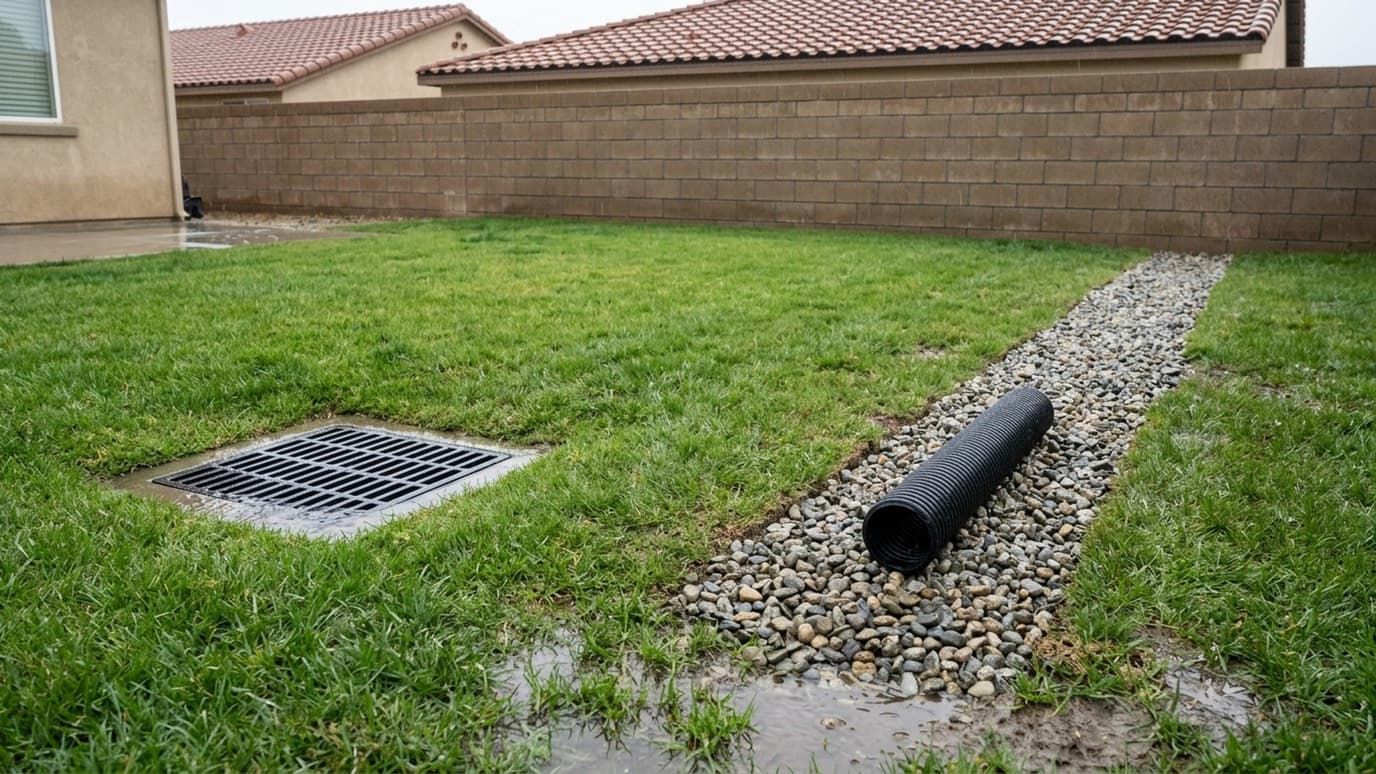
Rain gutters collect the roof's water and downspouts deliver it to a few spots on the ground. Where those spots are decides whether the water leaves the yard or sits against the house. On a Temecula tract lot, that comes down to three choices: a diverter, an extension, or a buried line. This guide compares them for Temecula's clay soil and tract lots. For the general options everywhere in the valley, see the downspout drainage options guide.
Roof water landing in the wrong place at your Temecula home? Describe where each downspout ends.
Why roof water needs a plan on Temecula clay
The USDA's description of the Auld series, found in the foothills and interior valleys of southern California, lists slow permeability, surface cracks a half inch to an inch and a half wide in dry periods, and prominent slickensides, the marks of clay that swells when wet and shrinks when dry. Water that a downspout drops at the base of a wall has little way to soak away from it.
The state's 2025 residential code, in section R801.3, says that in areas where expansive soils are known to exist, all dwellings and townhouses shall have a controlled method of water disposal from roofs, one that discharges roof drainage to the ground surface not less than 5 feet from foundation walls or to an approved drainage system. Whether a given lot falls under that rule is for the City's building department to say.
The housing makes it a common question. About 60 percent of Temecula's housing units, 22,878 of 37,813, were built between 1990 and 2009, according to the Census Bureau's American Community Survey (2020 to 2024 estimates, with a margin of error). Where each downspout on a house of that age ends is worth checking.
Diverters, extensions and buried lines
A diverter. A diverter is a fitting in the downspout that sends some or all of the water somewhere else, usually into a rain barrel. A rain barrel tips sheet published on lincolnconservation.org describes two types. A direct diverter captures all the water, so what happens when the barrel is full has to be planned. An automatic one is fitted through a hole in the side of the downspout, lets the excess continue down the downspout once the barrel is full, and can clog with leaves, so it should be checked several times a year. The point for drainage is the overflow. A diverter moves water; it does not give it a place to go.
An extension, splash pad or rock apron. The Vermont Department of Environmental Conservation's downspout disconnection sheet lists an extension, a swale, a splash pad or a small rock apron as ways to carry downspout water to a stable vegetated area. The U.S. EPA's page on redirecting downspouts says a downspout aimed at a driveway sends water to the street, and that redirecting may not be appropriate everywhere. These are the simplest option, and they only work where the ground beyond them slopes away.
A buried line to an emitter or an outlet. A buried line carries the water out of the narrow strip beside the house. A patent for a pop-up emitter describes one at the lowest end of a buried pipe, with a spring cover that opens under water pressure and reseals. The line needs continuous fall, and the end of it has to be a real outlet.
A decorative downspout or rain chain. These change how the water looks on the way down. They do not change where it ends up, so the questions above still apply.
Gutters come first
Everything above assumes the gutters deliver the water to the downspouts. Debris is why they sometimes do not. Riverside County's flooding guidance notes that leaves and broken limbs can clog drainages and make water back up. A gutter packed with leaves overflows at the wall, wherever the downspouts end. Clearing them before the first storm of the season is the simplest fix on the roof.
Where the water can go in Temecula
Two city facts shape the outlet. The City of Temecula's grading notes say existing drainage courses must continue to function at all times and ask that adjoining properties be protected during grading, so a downspout line cannot simply be aimed at a neighbor. And the City's 2005 stormwater management plan reports 52 miles of city-maintained underground storm drains. Whether roof water from a particular house may be tied into the street or a storm drain is a question for the City, and a connection nobody has approved is the mistake to avoid.
| Your lot | Usually fits | What rules it out |
|---|---|---|
| Tight tract side yard | A buried line carried to the front or back | No outlet at either end |
| Open backyard that slopes away | An extension or a buried line to an emitter | Flat ground that holds the water |
| A planted bed that stays dry | A disconnected downspout onto the planting | Clay that will not drain, or a bed that is already wet |
| Wanting to reuse the water | A diverter and barrel, with an overflow plan | No safe place for the overflow |
Want your Temecula downspouts moved or buried? Describe the house and where the water goes now.
Get yard drainage help in Temecula
These pages cover the work: downspout and gutter drainage in Temecula, yard and landscape drainage in Temecula, French drain installation in Temecula and grading and drainage correction in Temecula. If the water is already pooling at the wall, the foundation guide covers what to check.
FAQ
What is a downspout diverter?
A diverter is a fitting that sends water from a downspout to another place, most often a rain barrel. It needs an overflow plan for when the barrel is full, since the water still has to leave the roof somewhere.
How far from the house should a downspout discharge in Temecula?
Where the residential code's roof-drainage section applies, in areas known to have expansive soils, the water must reach the ground surface at least 5 feet from foundation walls or go to an approved drainage system. Water that runs back toward the house has not been moved at all.
Can I run my downspouts to the street?
Ask the City first. Temecula's grading notes require existing drainage courses to keep working and adjoining properties to be protected, and the City runs its own storm drain system. A connection that has not been approved can cause the problems it was meant to solve.