
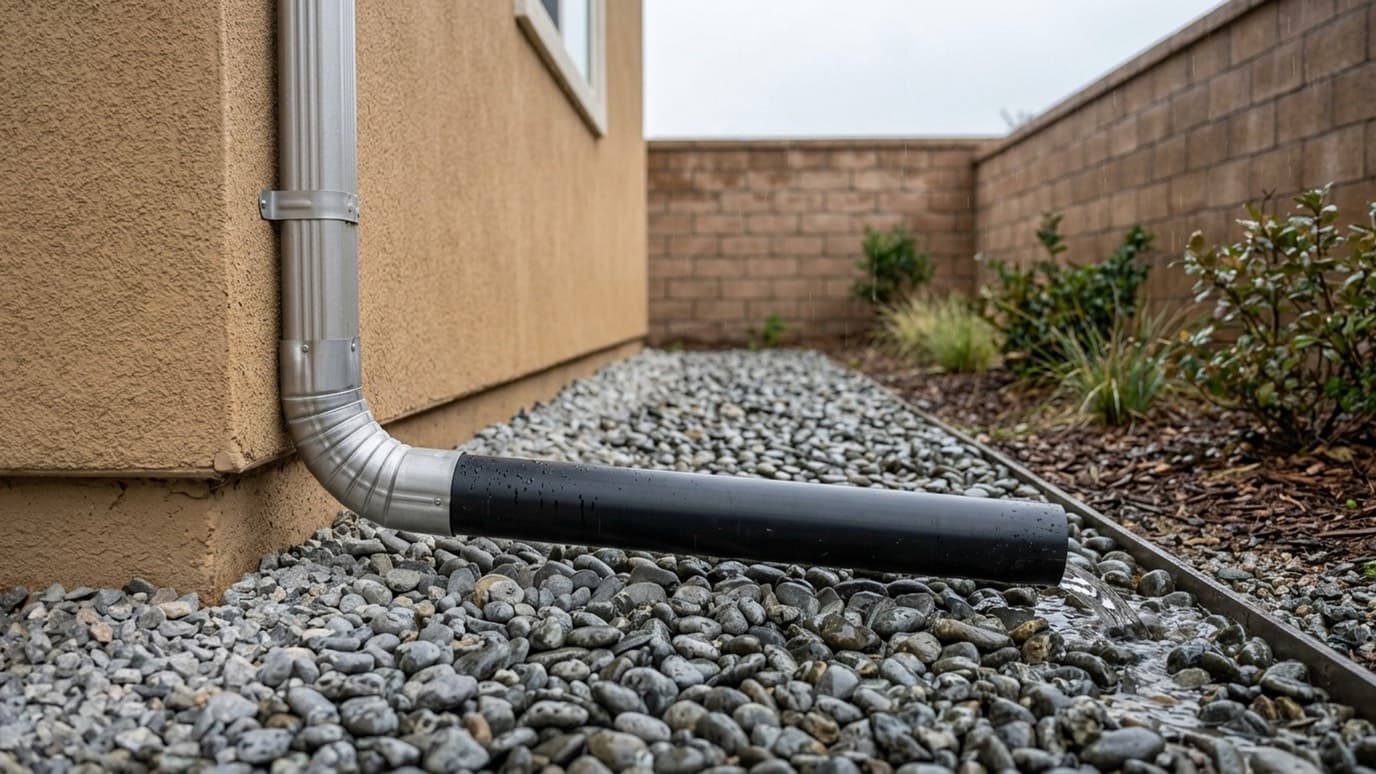
A roof gathers rain across its whole surface and hands it to the yard at a few points. Where a downspout empties decides where all of that water goes, and there are only a handful of ways to move it. They differ in how far they carry the water, what they need from the lot, and what can go wrong. This guide sets the options side by side and then matches them to the shape of a lot.
Roof water in the wrong place? Describe your lot and where each downspout ends.
Why roof water gets its own plan
The volume is larger than most people expect. One inch of rain running off a 1,000-square-foot surface comes to about 620 gallons, which is the arithmetic of the conversion, and Pender County, North Carolina gives the same rule of thumb as 625. A house with a roof several times that size, in a storm of a few inches, is delivering thousands of gallons, and the downspouts are where it all arrives.
California's residential code treats this as a design matter where the soil calls for it. The 2025 California Residential Code, in section R801.3, says that in areas where expansive soils or collapsible soils are known to exist, all dwellings and townhouses shall have a controlled method of water disposal from roofs, one that collects roof drainage and discharges it to the ground surface not less than 5 feet from foundation walls or to an approved drainage system. Why clay makes the wall base a poor place for roof water is covered in the guide to water pooling against a foundation.
If the water in the yard may not be coming from the roof at all, the yard flooding diagnosis guide sorts the usual causes.
The options
A short extension or splash block. The simplest fix is hardware on the end of the downspout that carries the water a few feet from the wall. It meets the 5-foot figure where that applies only if the extension actually reaches it, and only if the ground there slopes away. A short extension on flat ground moves the puddle by a few feet. Extensions lying across a path or lawn are also in the way, so they get kicked, moved or run over.
Underground pipe to daylight. A buried pipe takes the water farther, out of sight and out of the way, and lets it come out where the ground falls away, at the surface. The run needs continuous fall from the downspout to its outlet, and the end of it has to be an actual outlet, not just the end of a pipe. Buried pipe is also harder to clear if it clogs.
A pop-up emitter at the end of a buried pipe. An emitter is a fitting set flush with the ground at the low end of the line. A patent for one describes how it works: a spring holds a cover closed, water pressure in the pipe lifts the cover so the water escapes, and the spring reseals it when the pressure eases, keeping debris, insects and rodents out. Because it opens under pressure, it has to sit lower than the pipe feeding it, and it can be fouled by leaves and grit.
A rain barrel or a landscaped area. The U.S. EPA's page on redirecting downspouts describes sending the water to a rain barrel or onto a lawn or garden where it can soak in. It also warns that this may not be appropriate for all locations and that local regulations and where the water will end up should be considered. A barrel holds a small fraction of a storm, so it is a supplement.
A connection to a storm drain or the street. Where the lot has a real storm drain or curb outlet, a buried line can be tied into it. That is the option most dependent on permission, and the rules on it are covered in the driveway flooding guide.
Not sure where your downspouts should empty? Describe your lot and where the water goes now.
Choosing by the shape of the lot
No option is best everywhere. The lot decides, and the table keys on what the lot offers.
| What the lot offers | Usually fits | What rules it out |
|---|---|---|
| Open yard with room and fall away from the house | A buried line to an emitter or to daylight | No usable fall between the wall and the outlet |
| Tight side yard between houses | A buried line that runs to the front or back, to an emitter or a permitted curb connection | No outlet at either end, or no permission to connect |
| A real storm drain or curb outlet nearby | A buried line tied in, where it is approved | The agency will not approve a connection |
| Planted area that can take the water | A disconnected downspout onto the planting, or a barrel | Clay that will not drain, or ground that stays wet |
| Flat lot with no lower point | A design problem, not a product choice | Any option that relies on fall |
Planning the outlet
The outlet is half the design. Four tests apply to every option.
- Fall. The water has to travel downhill the whole way, and the point where it comes out has to be lower than where it went in.
- Distance. Where the code applies, at least 5 feet from foundation walls, or into an approved drainage system.
- Direction. Away from the house, and not onto a neighbor's property or a walkway. The EPA advises considering where the water will go to avoid property damage or unsafe conditions.
- Soil. An emitter or a grass area has to be able to shed or absorb the water it receives. The USDA's description of the Murrieta series puts the clay at 35 to 50 percent with slow permeability, so a spot that depends on soaking in is a poor bet.
Mistakes that put the water back
- Ending at the wall. A downspout that stops at the base of the wall puts a whole roof's runoff beside the foundation.
- Aiming at a hard surface. The EPA notes that a downspout pointed at a driveway sends the water to the street, and a driveway is a poor place to deliver it if it slopes toward the garage.
- Burying a pipe with nowhere to go. A buried line that dead-ends fills up and backs up the gutter.
- Putting the emitter too high. An emitter set higher than the pipe feeding it will not drain.
- Never cleaning it. Gutters, downspouts and emitters clog with leaves, and a clogged emitter can back the whole line up. Clearing them before the first storm of the season is the simplest maintenance on the system.
- Skipping the local rules. A connection to a storm drain may need a permit, and a lot inside a city may answer to the city.
Yard drainage help by city
The same causes show up across the valley, and the work depends on the lot. Yard drainage pages by city: Temecula, Murrieta, Menifee, Wildomar, Lake Elsinore, French Valley, Winchester, Homeland, Lakeland Village, Fallbrook and De Luz. For the services themselves, see yard and landscape drainage, French drain installation, grading and drainage correction and downspout and gutter drainage.
FAQ
How far from the house should a downspout discharge?
Where the California Residential Code's roof-drainage section applies, in areas known to have expansive or collapsible soils, the water has to go to the ground surface at least 5 feet from foundation walls or into an approved drainage system. Beyond that, the right distance depends on where the ground slopes, and water that runs back toward the house has not been moved at all.
Can I just bury a downspout and let it end underground?
Not without an outlet. Buried pipe has to end in one: daylight, an emitter, an approved connection or a place where the water can be absorbed. A pipe that ends in the soil fills up, and the water comes back out of the joints or the gutter.
Will a pop-up emitter work on clay soil?
It can, because an emitter releases water onto the surface and does not depend on the ground to take it in. What matters is that the water then has somewhere to run and does not sit. On slow-draining clay, an emitter set in a low spot that stays wet will not do the job.